Best Solo Ads Vendors List
The best solo ads vendors list isn't a ranking someone sells you — most "top 10" lists online are affiliate pages ranking whoever pays the highest commission. What actually separates a good vendor: a verifiable track record, tier-1 traffic, over-delivery, and named buyer reviews. Here is how to build your own shortlist and vet it.
Skip the “top 10 vendors” lists — they rank whoever pays the highest commission. A vendor with documented deliveries, named reviews and tier data beats any ranking.
See a documented archive →Why Most "Top 10 Vendors" Lists Can't Be Trusted
Search for "best solo ads vendors" and you'll find page after page of rankings. What almost none of them tell you: the order is usually decided by commission rates, not traffic quality.
The economics are simple. A review site signs up for every vendor's affiliate program, then ranks the vendors by who pays the most per referral. The "number one pick" is whoever offers the fattest or most recurring payout. The writer has rarely bought a single click from anyone on the page. That's why those articles are heavy on adjectives and empty of numbers — no opt-in rates, no delivery reports, no named buyers. No test was ever run.
I'm not against affiliate links. I'm against rankings disguised as research. The FTC's endorsement guides exist precisely because paid recommendations dressed up as neutral advice mislead buyers — and in solo ads it happens constantly.
I've sold solo ads since 2012, so I'll be upfront about my bias: I'm a vendor, and yes, I'd like your order. But instead of a ranked list of ten names I've never bought from, I'll show you how a real solo ads list is built, what separates a serious vendor from a click reseller, and how to test any vendor — me included — with a small order and a calculator.
How a Solo Ads List Is Actually Built and Maintained
You're not really buying "clicks" from a vendor. You're renting attention from their email list. So the first thing to understand about any vendor is where that list came from and what shape it's in.
There are two ways to build one. The slow way is organic: squeeze pages, content, giveaways — people who typed in their email because they wanted what you offered. The fast way is buying data: scraped addresses, co-registration leads, or lists purchased from someone else. Bought data produces subscribers who never asked to hear from the vendor, don't open, don't click, and certainly don't buy. Some of it isn't even human. When a vendor appears from nowhere with a "huge list," fast is usually the answer.
Building it is half the job. Maintaining it is the other half, and it's the part nobody talks about. I've mailed my list — one list, built organically — every single day for 14 years. Daily mailing sounds aggressive, but it does two things. It keeps the relationship warm, so subscribers still open. And it constantly surfaces dead weight: addresses that stopped opening get pruned, bounces get removed, and what remains is the active core. A list mailed once a month "to preserve it" is rotting quietly — engagement decays, spam filters notice, and by the time your ad goes out, half the addresses are ghosts.
This is why list age and activity matter far more than size. A vendor bragging about 300,000 subscribers is telling you nothing. Collected when? Mailed how often? Cleaned ever? A smaller list mailed daily for a decade and pruned relentlessly beats a huge stale one every time — and the difference shows up directly in your opt-in rate.
The Vendor Evaluation Checklist
When I evaluate whether a vendor is worth testing — and buyers should hold me to the same standard — I look for six things.
- Track record you can date. How long have they been selling under the same name? Years of continuous operation are hard to fake. Sellers who burn buyers rebrand and reappear; sellers who deliver stay put. I've operated under my own name since 2012 — a long, checkable history is the strongest proof there is.
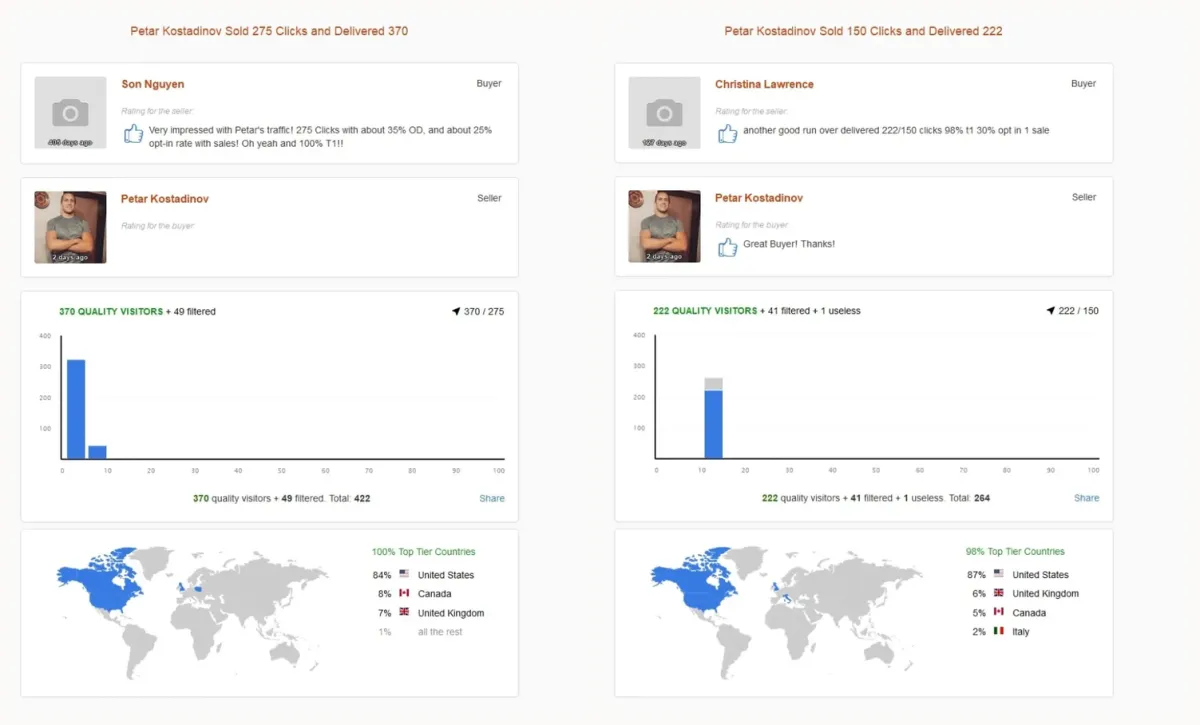
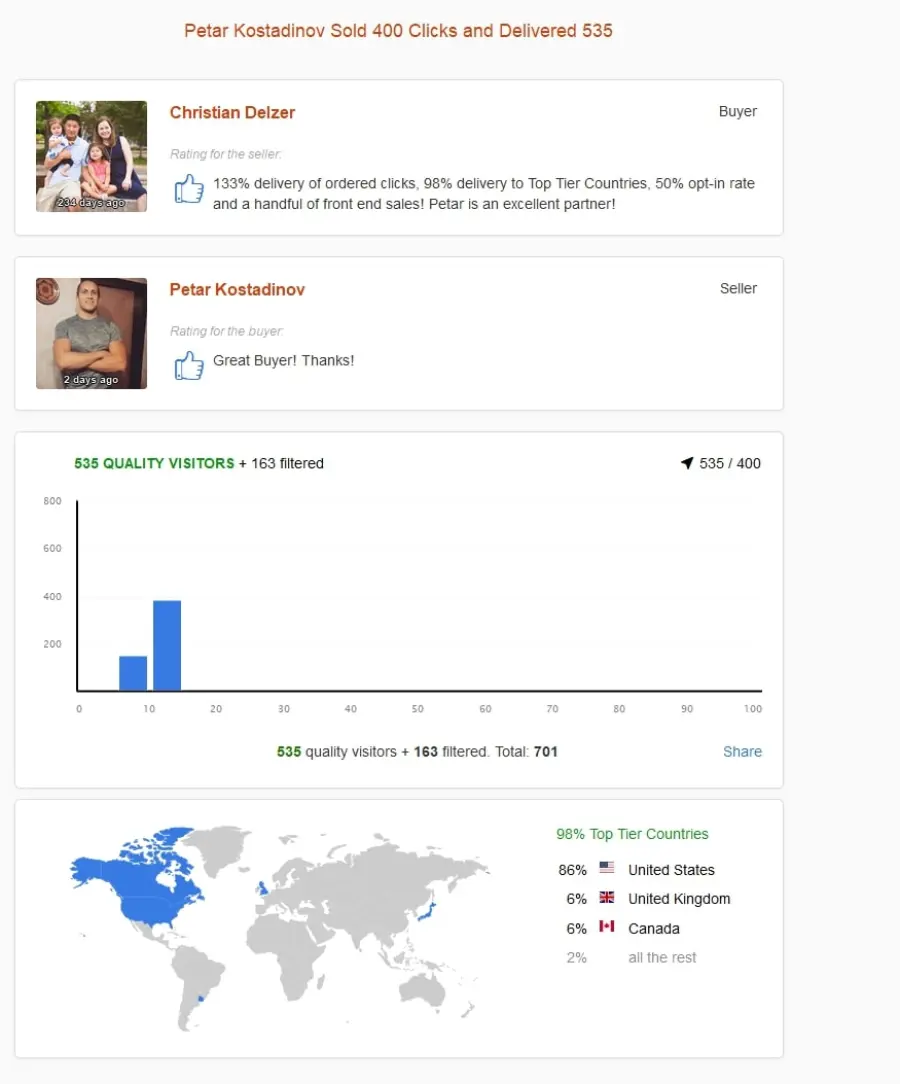
- Named reviews with numbers. "Great traffic, fast delivery!!" from an anonymous handle is worthless. What counts is a named buyer reporting figures: clicks ordered, clicks received, opt-ins, sales. I keep 400+ written reviews with screenshots public for exactly this reason — you can read what real buyers measured, not what I claim.
- Delivery reports. A serious vendor shows tracking: unique clicks, geography, timing. If a vendor can't show you what a completed order's report looks like, they're not tracking — or not delivering.
- Tier-1 share. Ask what percentage of clicks come from the US, UK, Canada, Australia and New Zealand, and expect a number. My traffic is 95% tier-1. A vendor who answers "mostly English-speaking countries" without a figure is telling you they either don't measure it or don't want you to see it.
- Over-delivery habit. Good vendors send more clicks than you paid for, as a buffer and a courtesy. I over-deliver 20% as standard — buyers have documented runs of 194 clicks delivered on a 191-click order, 257 on 191, and one run at 133% of the ordered amount. A vendor who delivers exactly 100 on 100, on the dot, is squeezing every click.
- Niche fit. A great list in the wrong niche is a bad buy. My list responds to Make Money Online, Internet Marketing, Business Opportunity, and Health & Fitness offers. If you're selling local plumbing services or B2B software, my traffic won't convert for you and I'll say so before you order. A vendor who takes every order regardless of fit is optimizing for their revenue, not your results.
Red Flags That Predict Fake Traffic
Some warning signs are so reliable that I'd treat any one of them as disqualifying.
Suspiciously cheap clicks from unknowns. Real tier-1 email traffic has a floor cost. My packages run $0.23–$0.28 per click; on Udimi, sellers list at $0.35–$0.95. When a stranger offers clicks at $0.10 or $0.15, ask what list could produce real traffic at that price. The usual answer: bots, click exchanges, or tier-3 traffic relabeled. You'll get your clicks — your tracker will show them — and your opt-in page will convert at 2%.
Unsolicited DMs. Vendors with a reputation and a review archive don't need to cold-message strangers on Facebook and Telegram. The accounts that slide into your inbox offering "premium solo ads" are almost always resellers or outright fakes. Sellers with real lists are found; they don't hunt.
No public reviews. Not "few" — none, or only screenshots of anonymous chat messages. Anyone who has delivered real results accumulates named, written feedback. Its absence, after any claimed time in business, is an answer in itself.
Guaranteed sales. This one ends the conversation for me. No honest vendor guarantees sales, because sales depend on your offer, your funnel and your follow-up — things the vendor doesn't control. I can control click volume, quality and delivery speed. I cannot promise you sales, and neither can anyone else. A vendor who does is lying or planning to fake the numbers.
Questions to Ask Before You Pay — and What Real Answers Sound Like
Before sending money to any vendor, ask these five questions. The content of the answers matters, but so does their precision — honest vendors answer in numbers and specifics, fakers answer in adjectives.
- How was your list built, and when did you start? A real answer names the method and the year: "organically, through my own opt-in pages, since 2012." Hype sounds like "we have a massive network of premium buyers."
- What share of your traffic is tier-1? A real answer is a percentage. Mine is 95% US, UK, Canada, Australia and NZ. "Mostly top-tier" is not a number.
- Do you over-deliver, and by how much? "20% standard on every order" is checkable against my delivered runs. "We always take care of our clients" is not.
- What exactly do I get with my order? With me: I write the ad copy for you and you approve it before it goes out, a buyers list is included on every order, and traffic starts within 24 hours. Vague answers here usually mean the vendor is brokering someone else's clicks.
- What's your refund policy? Buying direct means no marketplace escrow — the track record substitutes for it, so read the policy before ordering, not after. Mine states plainly that there are no refunds if your link doesn't work, which is why I check every link before sending. A vendor with no written policy at all is a vendor you'll argue with later.
If you'd rather have escrow while you're learning who to trust, a marketplace is a legitimate choice — I've written an honest breakdown in my Udimi review, including where the marketplace beats buying direct and where it doesn't.
The Test Protocol: Audition Vendors With Small Orders
Everything above filters the field. The final judge is a paid test, and it should be small.
Pick two or three vendors who survived the checklist. Order 100–200 clicks from each — that's $28–$54 at my rates, and Udimi's 50-click minimum keeps marketplace tests cheap too. Send every vendor's traffic to the same squeeze page with separate tracking links, so you're comparing lists, not funnels. If your funnel isn't ready yet, fix that first — my solo ads traffic guide covers the setup end to end.
Then compare one number above all: opt-in rate. Across 23 written reviews from my buyers who stated their results, the median opt-in rate is 43%, with a range from 17% to 83%. Use that as your reference point. A test that opts in at 35–45% is real, warm email traffic. A test at 10% means a cold or fake list — or a broken squeeze page, which is why you test the page first.
Sales can show up even at test volume, but treat them as a bonus, not the metric. One of my buyers, Aldona, ordered 200 clicks and got 110 opt-ins and 4 sales. Karim turned 125 clicks into 97 subscribers and a $37.23 commission. Leif spent $38, opted in 50% of his clicks, and landed one $97/month recurring sign-up. Michael saw a 28.5% opt-in rate and 11 sales on his second run. Those results are real, but not typical of every 100-click test — most small tests produce opt-ins and zero to a few sales, and the money is made mailing those subscribers afterwards.
Give each vendor a fair run, read the delivery report, count the opt-ins, then scale the winner. That's the entire method — no top-10 list required. If you want to include my list in your test, the order page shows every package, and the buying guide explains what happens after you click.
For evaluating high-profile agencies, see the agency vs marketplace vs direct comparison.
The evidence protocol: what to request, and when
Vendors respond to specific requests. Here is what to ask for at each stage, and what the answer tells you:
| Stage | Ask for | A good sign | A red flag |
|---|---|---|---|
| Before paying | A recent delivery report | Arrives in minutes, totals and geography visible | Excuses, or a screenshot with numbers cropped out |
| Before paying | Where the list opted in | A concrete answer (own funnels, since when) | "Various sources" |
| During delivery | Progress numbers on request | Live or same-day figures | Silence until the end |
| After delivery | The full report | Delivered vs ordered, uniques, tiers — unprompted | Just "done!" |
Every row costs the vendor two minutes if the operation is real. The vendors who bristle at the protocol are the ones it's designed to catch.
Before trusting any vendor's claimed numbers, check them against the documented medians on the solo ads benchmarks page.
Frequently asked questions
How do I find a legit solo ad vendor?
How do I avoid solo ad scams and bot traffic?
Are 'best solo ads vendors' lists trustworthy?
What makes a vendor's list high quality?
How much should I spend testing a new vendor?
What questions should I ask a vendor before buying?