Where to Buy Solo Ads
You can buy solo ads in two places: a marketplace like Udimi, where listed sellers charge $0.35–$0.95 per click plus fees, or directly from a list owner — my own packages run $0.23–$0.28 per click with 20% over-delivery. This guide covers both routes, the real costs, and how to test a seller safely.
First solo ad ever? Use a marketplace for the escrow. Already know your numbers? Buy direct — $0.23–$0.28 per click with a documented +38% median over-delivery.
Order clicks →The Two Ways to Buy Solo Ads
Every solo ad purchase happens one of two ways. You buy through a marketplace like Udimi, where hundreds of sellers list their prices and the platform sits in the middle. Or you buy direct from a seller who runs his own list and takes orders on his own site. I've been on the selling side since 2012, so I'll tell you plainly how each route works — including where the marketplace is genuinely the better choice.
A marketplace gives you escrow. Your money is held until clicks are delivered, the platform filters obvious bot traffic, and if a seller vanishes mid-order you get refunded. That protection matters when you're buying from a stranger with no track record. The cost of that protection is price: Udimi sellers list at $0.35 to $0.95 per click, and the platform adds fees on top. There's a subtler cost too — you rarely know how a marketplace seller's list was built or how often it gets hammered with offers.
Buying direct means no escrow. What substitutes for it is the seller's documented history. In my case that's 14 years of selling, one email list built organically and mailed daily, and 400+ written reviews with screenshots that you can read before spending anything. Direct pricing runs $0.23–$0.28 per click on my packages, every order gets 20% over-delivery as standard, and you know exactly whose list your offer is landing on — because there's only one.
| Marketplace (Udimi) | Direct (my site) | |
|---|---|---|
| Price per click | $0.35–$0.95 + fees | $0.23–$0.28 |
| Buyer protection | Escrow until delivery | Track record and reviews, no escrow |
| Over-delivery | Varies by seller | 20% standard on every order |
| List transparency | Many sellers, unknown lists | One list, built organically since 2012 |
| Ad copy | Usually you write it | Written for you, approved before send |
If you've never bought a solo ad and you want to sample several unknown sellers cheaply, the marketplace is the sane place to do it — I say as much in my Udimi review. If you'd rather buy once from someone whose results are public, direct is cheaper and simpler. Neither route guarantees sales, and anyone who promises them is lying to you.
Placing Your First Order, Step by Step
People imagine ordering a solo ad is complicated. It's three things.
- Pick a click package. Decide how many clicks you want to buy. For a first order with any seller, small is correct — more on that below.
- Supply your link. This should be an opt-in page (a squeeze page that collects email addresses), not a raw affiliate link. Test the link yourself on desktop and phone before you submit it. My refund policy is blunt about this: I don't refund orders where the buyer's own link didn't work, because the clicks were still sent and paid for.
- Handle the ad copy. On Udimi you'll usually write the email yourself or paste a swipe. When you order from me, I write the ad copy for you and you approve it before anything goes out. I've mailed this list daily for years — I know what it responds to, and a stranger's swipe file doesn't.
Then delivery starts. On my orders, traffic begins within 24 hours of approval. Clicks don't arrive as one dump; they flow in over the following hours and days as the list opens the email and clicks through — you'll see them land in your page analytics in real time. When the ordered total is reached, plus over-delivery, the run is complete and you get a report. Every order I send also includes the buyer list: the email addresses of people who came from your run, so the subscribers are yours even before your own opt-in form catches them.
If you want the deeper mechanics of what happens between the email send and the subscriber landing in your autoresponder, I walk through it in the solo ads traffic guide.
How to Read a Delivery Report
The delivery report is where new buyers either learn something or get fooled, so let's read one properly. Four numbers matter.
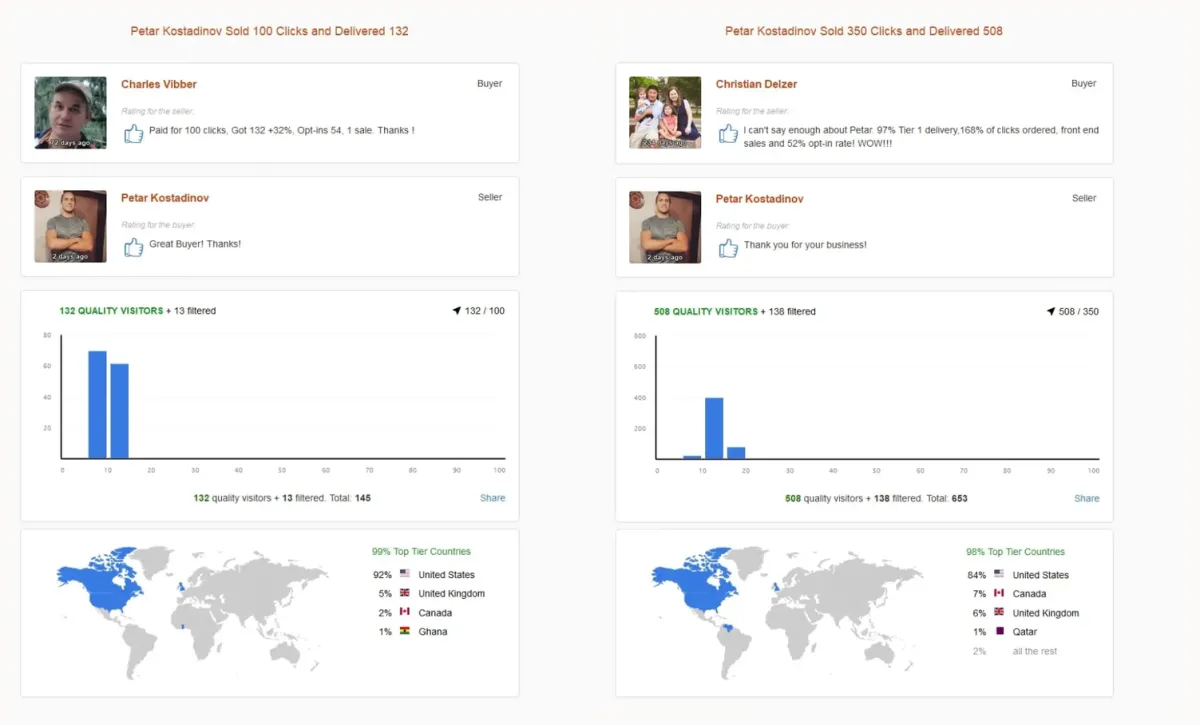
Clicks delivered versus clicks ordered. This is the contract. If you ordered 200 and got 178, the seller shorted you and you should raise it. Good sellers deliver over, not under. Here's what that looks like on my actual runs: one buyer, Josh, ordered 191 clicks and received 194. Another run on a 191-click order delivered 257 clicks. I've had runs come in at 133% of the ordered amount. The 20% over-delivery is the standard I aim for; sometimes the list is responsive that week and you get more. You never get less than you paid for.
Unique visitors. Raw clicks count repeat visits — someone opening your page twice is two clicks but one prospect. Unique visitors is the honest denominator for your opt-in rate. Reports and tracking tools show both; use uniques when you judge results.
Tier-1 percentage. This is the share of traffic from the US, UK, Canada, Australia and New Zealand — the countries where English-language offers convert and where buyers have buying power. My traffic runs 95% tier-1. Josh's report showed 99% top-tier on his run. If a report shows 40% tier-1 on clicks you paid tier-1 prices for, you overpaid.
Opt-ins. Not on the seller's report — this one is yours to track, in your autoresponder. It's the number that actually predicts whether the traffic can make you money. Across 23 written reviews of mine where buyers stated their results, the median opt-in rate was 43%, with a range from 17% to 83%. That range is honest: your page and your offer are half the equation, and no seller controls them.
What It Costs at Each Route
On Udimi, sellers set their own prices between $0.35 and $0.95 per click, the minimum order is 50 clicks, and new users typically get around $5 in credit to soften the first purchase. If you buy there regularly, Prime membership costs $19.95/month and adds stricter click filters and buyer discounts. So a realistic first marketplace order — say 100 clicks at $0.55 — lands somewhere near $55 before you've learned anything about the seller.
Buying direct from me, the packages are fixed and public:
| Clicks | Price | Per click |
|---|---|---|
| 100 | $28 | $0.28 |
| 200 | $54 | $0.27 |
| 300 | $78 | $0.26 |
| 500 | $125 | $0.25 |
| 800 | $192 | $0.24 |
| 1000 | $230 | $0.23 |
| 2000 | $550 | $0.275 |
Every package includes the 20% over-delivery, ad copy written for you, and the buyer list. You can see the current packages on the order page. One honest caveat before you spend anything: my list fits Make Money Online, Internet Marketing, Business Opportunity, and Health & Fitness offers. If you're selling outside those niches — local services, e-commerce gadgets, B2B software — my traffic is the wrong tool and I'll tell you so. Compare a few vendors against your niche first; my providers comparison is a reasonable starting point.
How to Test a New Seller Safely
Never make your first order with any seller — me included — a big one. The test protocol is simple and costs $30–60.
Order 100 to 200 clicks. From my packages that's $28 or $54; on Udimi, 50–100 clicks from a mid-priced seller lands in the same band. Send the traffic to your opt-in page with tracking in place, then measure three things: did the clicks arrive in full and on time, what percentage was tier-1, and what was your opt-in rate on unique visitors. That's the whole test. You are not measuring sales on 100 clicks — the sample is too small for that verdict.
Small orders tell you plenty. One of my buyers, Leif, spent $38 on a test run, got a 50% opt-in rate, and picked up a $97/month recurring sign-up from it. Karim's 125-click order produced 97 subscribers and his first $37.23 commission. Neither of those runs made anyone rich. Both proved the traffic opts in, which is the only question a test order needs to answer. If the test clears — clicks delivered in full, tier-1 as advertised, opt-in rate you can live with — scale to 300 or 500 clicks with the same seller rather than restarting the audition with a new one.
Mistakes First-Time Buyers Make
I've watched buyers repeat the same four errors for over a decade. Skip these and you're ahead of most people ordering their first solo.
Sending traffic to a raw affiliate link. This is the most expensive mistake on the list. Clicks go straight to a sales page, a few percent buy, and everyone else disappears forever. Route the same clicks through an opt-in page and you capture a big share of them as subscribers first — my buyers' median is 43% — and can follow up for months. Aldona sent 200 of my clicks to a squeeze page, captured 110 opt-ins, and made 4 sales; without the page she'd have kept only the sales and lost the 110 names. How that capture-then-follow-up loop works is the subject of this walkthrough.
Buying the cheapest clicks on the board. A $0.30 marketplace click from a bottom-ranked seller is not a bargain if half the traffic is bot-filtered leftovers from a list of unknown origin. Judge sellers on documented delivery and buyer-reported opt-in rates, not on who shaved three cents off the click price.
Judging a test on sales instead of opt-ins. A 100-click run that produces zero sales but a 40% opt-in rate is a successful test. Sales come from your offer and your follow-up, often on the second or third contact — Michael's first run was quiet; his second pulled a 28.5% opt-in rate and 11 sales. The traffic didn't change between those runs. His follow-up did.
Having no follow-up sequence loaded. If subscribers land in an autoresponder that sends them nothing, you paid for names you'll never speak to. Write at least a handful of follow-up emails before the traffic starts, not after. One of my buyers, Mutiara, saw a 34% opt-in rate — and then a third of those subscribers took her CPA offer, because the emails behind the opt-in page were ready and did the selling.
Buy small, send clicks to an opt-in page, judge the run on delivery and opt-ins, and let the follow-up emails do the selling. That's the whole craft of buying solo ads. When you're ready to run the test yourself, the order page has the packages, and the reviews show you what other buyers' reports looked like before you risk a dollar.
Full price analysis: how much solo ads really cost.
Marketplace route explained step by step: how Udimi actually works.
If a delivery disappoints: the escalation path
Orders occasionally go wrong everywhere. What separates fixable from unfixable is how you escalate:
- Assemble evidence first. The delivery report, your tracking numbers (unique clicks, geography if you track it), and your opt-in count with timestamps. Screenshots, not descriptions.
- Name the specific gap. "1,000 clicks but 82 uniques in my tracker" is actionable; "the traffic was bad" is not.
- Ask for the specific remedy. Re-delivery of the shortfall is the standard fix for delivery gaps; refunds apply to non-delivery, not to disappointing results — that line is in every serious seller's terms, including mine.
- Judge the response. A professional answers with numbers within a day. Silence or blame tells you everything you need for the next order decision.
Frequently asked questions
Where is the best place to buy solo ads?
How much do solo ads cost per click?
How many clicks should I buy to start?
Is it safe to buy solo ads outside a marketplace?
What do I need before buying my first solo ad?
What should a delivered order look like?