Igor Solo Ads Review: Agency vs Marketplace vs Direct Seller

Igor Kheifets runs igorsoloads.com, an agency-model solo ad business known for its "conversion guarantee" positioning. Honest answer up front: the public record on him is thin — four Trustpilot reviews (none newer than 2021) and one third-party result from 2011 — so I can't tell you whether his traffic is good in 2026. What I can do is show you the documented facts and teach you to verify any seller, including me.
The public record on Igor Solo Ads is thin and old — a handful of Trustpilot reviews from 2021, one detailed result post from 2011. That's not a verdict either way. The useful question is the model comparison: agency vs marketplace vs direct seller — and the evidence standard you should demand from all three, me included.
How I document my own orders →Who Igor Kheifets Is
Igor Kheifets is one of the best-known names in solo ads. His business, igorsoloads.com, runs on the agency model: you don't pick a specific list owner from a menu, you buy traffic from the brand, and the agency fulfils the order from lists it owns or brokers. His site's positioning is built around a "conversion guarantee" — the promise that you're paying for some form of result, not just raw clicks.
That's a genuinely different pitch from most of the market. Marketplace sellers on Udimi compete on price per click and public ratings. Direct sellers like me compete on a published track record. An agency competes on brand and on the guarantee itself. None of these models is automatically honest or automatically shady — they just fail in different ways, which is what most of this review is about.
One thing I want to say plainly before the next section: nothing in the public record proves Igor's current traffic is bad, and I'm not going to claim it is. I have no test order of my own to show you, and secondhand opinion isn't evidence. What follows is the documented record, all of it, with its weaknesses stated.
What the Public Record Actually Shows
Here is everything I could find that's attributable to a source, good and bad.
Trustpilot: 2.8/5 from four reviews. The Trustpilot page for igorsoloads.com shows a 2.8/5 rating from four reviews, all of them 1-star, the newest dated June 2021. Two caveats, both real. Four reviews is a tiny sample — my own page has 400+ written reviews and even that doesn't capture every buyer. And nothing newer than 2021 means this tells you almost nothing about the business in 2026. A handful of old complaints is a yellow flag to investigate, not a verdict.
A 2011 third-party result — a good one. A post on soloaddirectory.com from 2011 reported a buyer's run with Igor: 604 clicks, a 42% opt-in rate, and a cost of $0.33 per subscriber. Those are strong numbers. They are also fifteen years old. Lists churn, teams change, traffic sources change; a 2011 result says nothing about what you'd get in 2026, in either direction.
A 2020 blogger test — good opt-ins, zero sales. A review on wealthanize.com (October 2020) documented three MLM campaigns bought from Igor: opt-in rates of 46.9% and 44.5%, but zero sales, and the blogger concluded "don't buy." I'll cite it because it exists — and then push back on the conclusion, because I think it's unfair to Igor. Opt-in rates in the mid-40s mean the traffic was real people who took an action. When subscribers arrive and nobody buys, the follow-up sequence and the offer are at least as suspect as the clicks. I'd say the same if that test had been run on my traffic.
A Ripoff Report complaint exists. One complaint about the business appears on ripoffreport.com. Anyone can file a Ripoff Report; they're unverified and the site never removes them, so a single complaint against a business that has run for well over a decade proves very little. I mention it only for completeness.
That's the whole record I can attribute. Four stale reviews, one ancient good result, one mixed 2020 test, one unverified complaint. It doesn't support "Igor is great" and it doesn't support "Igor is a ripoff." It supports exactly one conclusion: you cannot verify his current quality from public sources, so if you want to buy, you have to test.
The Real Question: Agency vs Marketplace vs Direct Seller
Whether to buy from Igor is really a question about which structure you want to buy under. The three models distribute risk differently, and knowing where each one is weak matters more than any individual review.
| What to compare | Agency (e.g. Igor Solo Ads) | Marketplace (e.g. Udimi) | Direct seller (e.g. me) |
|---|---|---|---|
| Pricing transparency | Not published — you request a quote or book a call | Fully public: sellers list $0.35–$0.95/click, minimum 50 clicks | Fully public: $28 for 100 clicks up to $550 for 2,000 ($0.23–$0.28/click) |
| Payment protection | Whatever the agency's guarantee terms say — read them closely | Escrow: seller isn't paid until clicks are delivered | None — the published track record substitutes for escrow |
| Over-delivery norms | Not publicly documented | Varies per seller; visible in their stats | 20% standard on every order, shown in delivery reports |
| List ownership | Agency owns or brokers lists; you don't know which list you got | Each seller mails their own list; quality varies seller to seller | One list, built organically since 2012, mailed daily |
| Verifiability | Testimonials on the sales page; little third-party data | Public ratings with a "got sales" marker on each review | 400+ written reviews with screenshots, delivery reports included |
Read the columns as trade-offs, not a ranking. The agency model's strength is convenience and a single accountable brand; its weakness is opacity — you can't see the list, the price, or the delivery norms before you commit. The marketplace's strength is structural protection: escrow and public per-seller ratings mean a bad actor gets filtered fast, which is why I tell beginners a carefully chosen marketplace seller is often the safest first purchase. Its weakness is that quality swings wildly between sellers and the good ones price accordingly. Buying direct is cheapest and most transparent when the seller documents everything — and it's the worst option when they don't, because there's no escrow to catch you. If you're new to this market entirely, my solo ads traffic guide covers how the mechanics work before you spend anything.
How to Evaluate Any High-Profile Seller Before Paying
Fame is not evidence. A big personal brand tells you someone is good at marketing themselves, which is related to — but not the same as — mailing a responsive list. Here's the standard I'd apply to Igor, to any name on my vendors list, and to me.
Ask for delivery reports from the last 90 days. Not testimonials — reports: clicks ordered, clicks delivered, dates, geography. Any active seller has these on hand. "Trust me, we deliver" is not an answer; a screenshot from 2019 isn't either.
Look for named reviews with numbers. "Great traffic, fast delivery!" from Anonymous is worth nothing. "Ordered 191, got 194, 100 opt-ins, 3 sales" from a named buyer is checkable and specific. Volume matters too — four reviews, whether glowing or angry, is a rounding error.
Get the guarantee in writing and define its terms. A "conversion guarantee" sounds strong, but the word conversion is doing all the work. Does it mean opt-ins or sales? What's the threshold, and what's the remedy — a refund, or more clicks from the same list that underperformed? A guarantee whose terms you can't read before paying isn't a guarantee yet; it's a slogan. This applies to every seller's promises, including my own published terms.
Run a small test before a big order. Buy the minimum. Use your own tracking link, not just the seller's numbers. Measure opt-in rate against your list's baseline, watch where the clicks come from, and check whether subscribers open your follow-up emails over the next week — real subscribers do, bot sign-ups don't. Scale only what the test supports. On a quote-based agency, insist on a small first order too; a seller who won't sell you a small test is telling you something.
My Numbers, for Symmetric Transparency
I've asked you to hold Igor to an evidence standard, so here I am held to the same one. I've mailed one organically built list daily since 2012. Prices are public: $28/100 clicks to $550/2,000, which is $0.23–$0.28 per click. Every order gets 20% over-delivery as standard — documented runs include 194 delivered on 191 ordered, 257 on 191, and a 133% delivery run. Traffic is 95% tier-1 (US, UK, Canada, Australia, NZ), and across 23 written reviews that state their numbers, the median reported opt-in rate is 43%, with a range of 17% to 83%. At my prices and that median, a subscriber costs about $0.65.
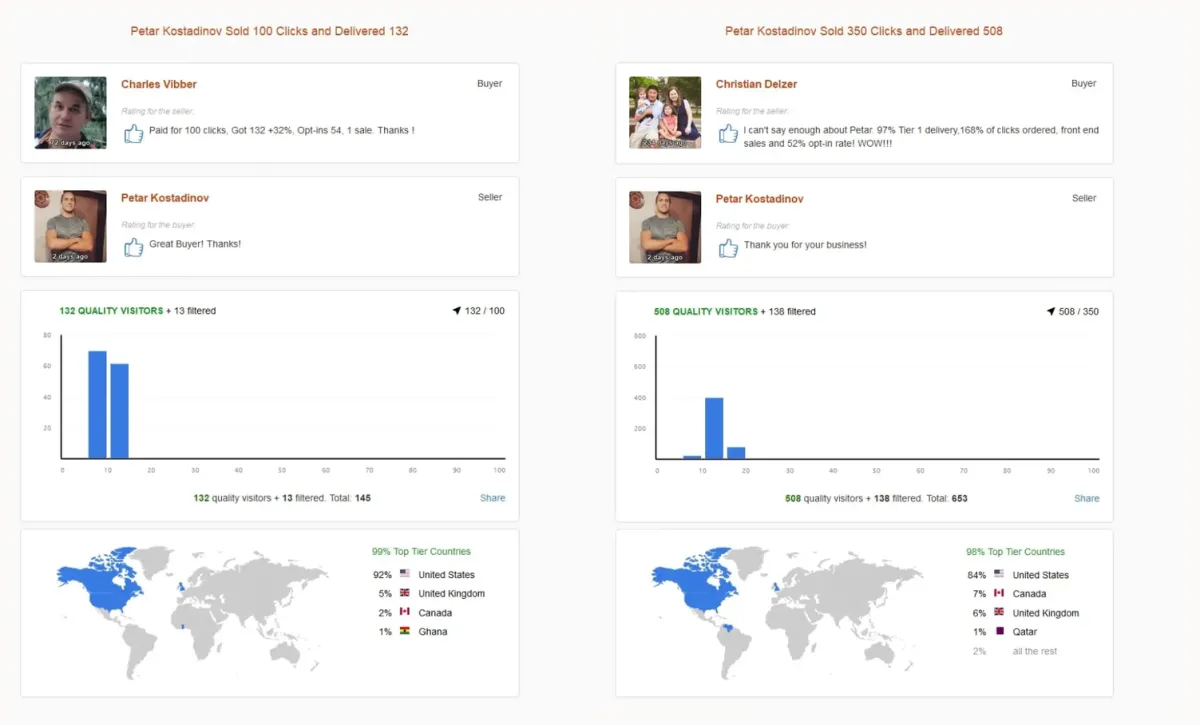
The limits, stated plainly: I sell clicks and document opt-ins; nobody can guarantee sales, because your offer and follow-up decide those. My list fits Make Money Online, Internet Marketing, Business Opportunity, and Health & Fitness — outside those niches, I'll tell you to buy elsewhere. And there's no escrow when you buy from me directly, which is precisely why the 400+ written reviews with screenshots exist: they're the substitute. Check them the same way I've told you to check everyone else's.
Four questions for any big-name seller
A famous name changes the marketing, not the mechanics. Before paying celebrity prices, ask what you'd ask anyone:
- Who actually mails? Large operations often fulfill orders through a team or partner lists. You're buying the list, not the personal brand.
- Can I see a delivery report from this month? Reputation is history; the report is the present.
- What's the top-tier percentage on my order, in writing, before payment?
- What happens if delivery falls short? The remedy (re-delivery of the shortfall) should be stated before money moves, not negotiated after.
A professional operation answers all four in one email. Hesitation on any of them is your answer.
Frequently asked questions
Is Igor Solo Ads legit?
How much does Igor Solo Ads charge?
What is a "conversion guarantee" actually worth?
Agency vs marketplace — which is safer for a first order?
How do I verify any solo ad seller before paying?
Do old reviews and results still count?