Solo Ads Traffic Guide
Solo ads traffic is email traffic: real subscribers clicking from a list owner's email to your page. It converts differently from search or social — colder on the first click, strong in the follow-up. This guide covers how the clicks work, what they cost, and how buyers turn them into opt-ins and sales.
Solo ads traffic pays when it lands on an opt-in page: 43% median opt-in across documented reviews, with the sales coming from the follow-up sequence — not the first click.
How ordering works →What Solo Ads Traffic Actually Is
Solo ads traffic is email traffic. Somebody with a large email list — in my case, one list I've been building organically and mailing daily since 2012 — sends an email about your offer to their subscribers. The people who click the link in that email land on your page. Those clicks are what you're buying. Nothing else.
That one sentence explains most of what people get wrong about this traffic. The subscribers on my list didn't type your product name into Google. They didn't see your ad three times on Facebook. They opened an email from a sender they know, read a short piece of ad copy, and clicked because the promise interested them. They're curious, they're in the make-money-online and internet-marketing space, and many of them have bought things from emails before — but at the moment of the click, they've never heard of you.
Compare the intent levels honestly. Search traffic is a person hunting for a solution right now. Social traffic is a person interrupted mid-scroll by a creative that caught them. Solo ads traffic sits in its own spot: warmer than a cold social impression because these are proven email openers and clickers, colder than search because there's zero brand recognition on the first visit. The rest of this guide is about working with that behavior instead of against it.
Who's on the list matters more than any other variable. My subscribers came in organically over 14 years, and the niches the list fits are Make Money Online, Internet Marketing, Business Opportunity, and Health & Fitness. If your offer is outside those, I'll tell you before you spend a dollar, because the clicks will arrive and nothing will happen. More on that at the end.
The Journey of One Click
Here is what happens between me hitting send and a visitor arriving on your page. Most guides skip this part because they've never sent the traffic. I send it every day.
First, the email itself. On every order I write the ad copy for you and you approve it before anything goes out. This isn't a courtesy — the copy is the targeting. A vague "click here for something cool" email produces vague clicks. Copy that names the promise your landing page actually makes produces clicks from people who want that specific thing. Traffic starts within 24 hours of your order.
Second, filtering. Raw email clicks are messy. The same subscriber opens the email twice and clicks both times. Automated link-checkers fire on the link. A bot hits the URL. None of that should cost you money, so bot traffic and duplicate clicks are stripped out before they count — only unique, real visitors count against the number you bought. When I say you ordered 200 clicks, I mean 200 filtered, unique humans — not 200 log entries.
Third, tier filtering. Clicks are graded by country. Tier-1 means the US, UK, Canada, Australia, and New Zealand — the countries where English-language offers convert. My traffic runs 95% tier-1. Check this with any seller you ever buy from, because a click from a tier-1 country and one from a country where your $97 offer equals a week's wages are not the same product, even though they look identical in a hit counter.
Fourth, over-delivery. I send 20% more clicks than ordered, on every order, as standard. Buyers have documented it in their reviews: 194 delivered on an order of 191, 257 delivered on another 191-click order, one run at 133% delivery. The margin exists so that even after the strictest counting, you got at least what you paid for.
Then the click lands on your page, and my job hands off to your funnel. Which brings us to the part that decides whether you make money.
The Funnel That Turns Clicks Into Subscribers
If you take one thing from this guide, take this: never send solo ads traffic straight to a sales page. Direct linking is the single most common way buyers waste money, and I say that as the person who profits either way.
Think about the visitor. They clicked an email from someone else's list thirty seconds ago. They don't know you, your product, or your story. Ask them for $97 on that first page and nearly all of them will leave — and you have no way to reach them again. The traffic didn't fail; the funnel did.
The funnel that works is short and boring, and it works precisely because it matches how this traffic behaves:
- Opt-in page. One page, one headline, one form, one free thing worth giving an email address for. No navigation, no ten paragraphs. The only job of this page is turning an anonymous click into a subscriber on your list.
- Thank-you page. The new subscriber is warmer right now than they will be for days. This is a fine place to present your offer for the first time — some will buy immediately, and a first-day sale that offsets part of your traffic cost is a bonus, not the plan.
- A 5–7 email follow-up sequence. This is where solo ads traffic actually converts. Over the next week your emails do what a single page visit can't: introduce you, deliver the free thing, tell a story, handle objections, and ask for the sale more than once. Cold on the first click, strong in the follow-up — that's the shape of this channel.
Notice what you're really buying when the funnel is set up right. Not visitors — subscribers. The click is rented; the email address is owned, and you can mail your list for years. I've written a full walkthrough of that mechanic in how solo ads generate leads for affiliate marketing, and if you're brand new to the model, start with the beginner's guide to solo ads traffic.
The Numbers That Matter (and What's Realistic)
Three metrics tell you almost everything about a solo ad run: opt-in rate, tier-1 share, and cost per subscriber. Sales matter too, obviously — but sales depend on your offer and your sequence, while these three measure the traffic and the front of your funnel.
Opt-in rate is subscribers divided by clicks. Across 23 written reviews from my buyers who stated their results, the median opt-in rate is 43%, with a range from 17% to 83%. That spread is honest and worth staring at. Same traffic, same list, same seller — and one buyer converts 17% while another converts 83%. The difference is the opt-in page. A clean page with a strong free offer sits around the median or above it; a cluttered page or a weak bribe sits at the bottom of the range no matter whose traffic you buy.
Tier-1 share you already understand: my traffic is 95% top-tier, and buyers verify it independently — Josh measured his own run at 99% top tier with his tracker.
Cost per subscriber is where it all lands. Here's a worked example with real numbers from a real buyer. Aldona ordered 200 clicks — that package costs $54, which is $0.27 per click. She got 110 opt-ins, a 55% opt-in rate. So her cost per subscriber was $54 ÷ 110 ≈ 49 cents. She also made 4 sales, but set those aside for a second: for $54, she added 110 people to a list she owns and can mail indefinitely. At the median 43% opt-in rate, the same $54 order produces about 86 subscribers — roughly 63 cents each. That's the realistic middle of the road, not a best case.
Run your own numbers the same way before you order: package price ÷ (clicks × your expected opt-in rate). If you don't know your opt-in rate yet, assume something below the median for your first run and let the data correct you.
From Subscriber to Sale
I won't promise you sales, and you should walk away from any seller who does. What I can show you is what buyers report, verbatim, in the 400+ written reviews with screenshots on my testimonials page — and the pattern inside those reports.
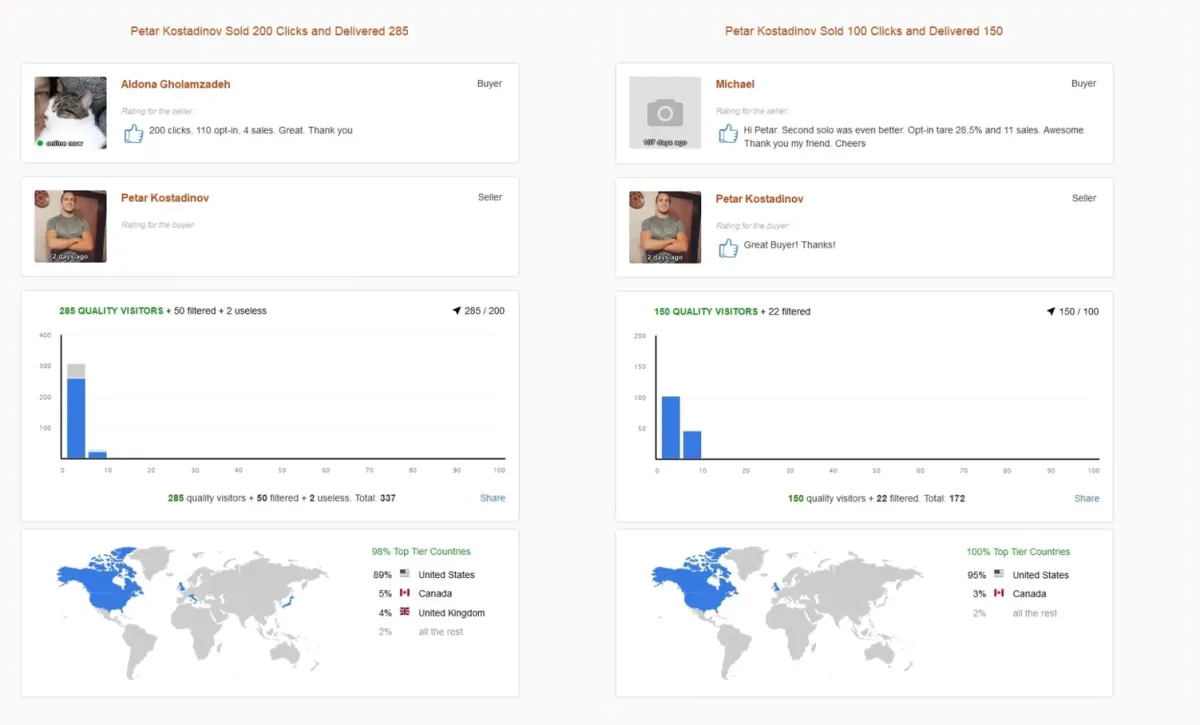
Michael got a 28.5% opt-in rate on his second run — below my median — and 11 sales. Josh ordered 191 clicks, received 194 at 99% top tier, collected 100 opt-ins, and made 3 sales. Karim turned 125 clicks into 97 subscribers and a $37.23 commission. Leif spent $38, converted 50% of his clicks into subscribers, and one of them signed up for a $97/month recurring program — a single subscriber who, as long as they stay, outearns the entire ad spend every month. Mutiara hit a 34% opt-in rate and got 33% of those subscribers to take her CPA offer.
Look at what those cases have in common. Michael's numbers are the clearest lesson: a below-median opt-in rate and the most sales of the group, because sales are made by the offer and the follow-up sequence, not by the front-end percentage. Leif's case is the other lesson: with recurring and higher-ticket offers, one buyer can carry a whole campaign, which is why judging a solo ad by day-one revenue alone usually undercounts it. The sales happen in the sequence — day three, day five, the second promotion you send that list a month later. Buyers who treat the click as the finish line get bounces. Buyers who treat it as the starting line get results like these.
How Solo Ads Traffic Compares to Everything Else
Where solo ads win: price certainty and speed. My clicks are a fixed $0.23–$0.28 each depending on package size — you know your cost before you spend, while Google and Facebook run auctions where your cost per click moves with competition and your account history. There's no ad account to warm up, no algorithm to please, and no waking up to a banned account. Traffic starts within 24 hours, so a funnel test that takes weeks of budget on the auction platforms takes days here. On marketplaces like Udimi, sellers list at $0.35–$0.95 per click plus a $19.95/month Prime membership if you want the extras — I've broken that down in my Udimi review — and buying direct skips the middleman's cut, with a 14-year public track record standing in for the marketplace's escrow.
Where solo ads lose, and I'd rather tell you now than after you've paid me: this traffic only works when your offer matches the list. Mine fits Make Money Online, Internet Marketing, Business Opportunity, and Health & Fitness. If you sell local plumbing services, e-commerce gadgets, or B2B software, solo ads are the wrong tool — search traffic will beat this channel every time for local and buyer-intent keywords, because those people are looking for you specifically. Solo ads also won't build a retargeting audience the way social ads do, and no seller, me included, can guarantee sales — only real, filtered, tier-1 clicks delivered fast.
I've written a full head-to-head comparison in solo ads vs Google Ads vs Facebook Ads if you want the long version. The short version: if your offer fits the niches above and you have an opt-in page and a follow-up sequence ready, solo ads are the fastest, most predictable way to put real subscribers on your list — and if it doesn't fit, keep your money, because no amount of good traffic fixes a mismatched offer.
Running a network marketing offer? The MLM solo ads guide covers the specifics.
Audit any delivery report in five minutes
When an order finishes, don't just glance at the total. Run these five checks, in this order:
- Delivered vs ordered. Anything at or above the promised amount passes; documented sellers routinely land higher — my median is +38% across 15 reports with visible totals.
- Unique visitors vs raw clicks. A big gap between the two means duplicates were filtered — that's the system working, not a problem.
- Tier breakdown. Compare the report's top-tier share against what was sold. 95% tier-1 promised and 70% delivered is a conversation to have, with the report attached.
- Opt-in count against clicks. Divide subscribers gained by unique clicks. Under 20% points at your page first, the list second.
- Timing. Clicks spread over hours look like a real mailing; a thousand clicks in ten minutes deserve questions.
Five minutes, five numbers — and you'll know more about the order than most buyers ever check.
Frequently asked questions
Is solo ads traffic real or bots?
Does solo ad traffic actually convert?
Why don't solo ads convert on the first click?
What funnel do I need for solo ads traffic?
What's a good opt-in rate for solo ad traffic?
How is solo ads traffic different from Facebook or Google ads?