What Are Solo Ads?
A solo ad is an email a list owner sends to their subscribers promoting only your offer — you pay per click on your link. It's the fastest way to put an offer in front of an email audience without owning a list. Here is how it works, what it costs, and the results real buyers report.
Solo ads are rented email clicks that build your list. They're worth it when your funnel captures emails and your niche lives in inboxes — MMO, IM, BizOpp, Health.
See packages →How a Solo Ad Actually Works, Step by Step
I've been selling solo ads since 2012, from one email list I built organically and mail every day. So let me walk you through what actually happens after you place an order — because most explanations stop at "someone emails their list for you," and that skips everything that determines whether you get real traffic or junk.
Here is the full sequence, from my side of the desk:
- You place the order and submit your link. You tell the seller how many clicks you want and where they should go — almost always a squeeze page with an opt-in form, not a sales page. I check every link before anything else happens. If it's broken, slow, or blocked, the send waits until it's fixed.
- The send gets scheduled into the mailing calendar. A list can only absorb so many promotions. I mail daily, so each day's slot goes to a specific buyer or to content that keeps the list responsive. Your order gets a date and a slot. With me, traffic starts within 24 hours; on marketplaces it depends on the seller's queue.
- The ad copy gets written. A good seller writes the email themselves, because they know what their subscribers open and click. I write the copy for every order and send it to you for approval before anything goes out. If a seller asks you to write the email to their list, that tells you they don't know their own audience.
- The email goes out. One email, one offer — yours. That's the "solo" in solo ad. Your link isn't buried in a newsletter next to five other promotions.
- Clicks get filtered and counted. Raw clicks include bots, duplicates, and traffic from countries you didn't pay for. Tracking software strips those out, so the number on your report is filtered, unique clicks — and you can verify it against your own tracker.
- You get a delivery report. Mine shows clicks delivered versus ordered and the country breakdown. On top of that I send the list of subscribers the ad generated for you, so you can cross-check it against your autoresponder.
One more thing that surprises buyers: over-delivery. Sellers who run their lists properly send more clicks than you paid for, as a margin of goodwill and because email traffic is hard to cut off at an exact number. My standard is 20% extra on every order. Documented runs include 194 clicks delivered on a 191-click order, another at 257 on 191, and one that landed at 133% of what was purchased. If a seller delivers exactly the number ordered, to the click, every time — that precision is usually software, not subscribers.
Who Solo Ads Fit — and Who They Don't
Solo ads are a niche tool, and I'd rather tell you upfront when they're the wrong one than refund you later.
They work when three things line up: the seller's list matches your market, your offer captures emails before it tries to sell, and you follow up. My list responds to Make Money Online, Internet Marketing, Business Opportunity, and Health & Fitness offers. Those niches share a trait — the subscribers opted in to hear about exactly this kind of offer, and they buy from email.
Now the other side, because this is where most disappointed buyers went wrong before the traffic ever arrived:
- Local businesses. My clicks are 95% tier-1 — US, UK, Canada, Australia, New Zealand — but they're spread across those countries. A dentist in Ohio gains nothing from a subscriber in Manchester. No solo ad list can target a city.
- Ecommerce cold products. Sending list traffic straight at a $40 gadget's product page fails. These subscribers respond to opt-in funnels, not shopping carts. Retargeted social ads do that job better — I compare the channels honestly in solo ads vs Google Ads vs Facebook Ads.
- Anyone without a follow-up sequence. If a click doesn't land on an opt-in page backed by an autoresponder, you're renting attention for one second and keeping nothing. The subscriber is the asset. Here's how a solo ad turns into a lead when the funnel is set up right.
If you're in the right niche with a working funnel, keep reading. If you're not, save your money — I mean that.
What Solo Ads Cost
There are two ways to buy: through a marketplace or direct from a seller.
On Udimi, the biggest marketplace, sellers list clicks at roughly $0.35 to $0.95 each. The minimum order is 50 clicks, new users get about a $5 credit, and the optional Prime membership runs $19.95 a month. The marketplace's value is escrow and public ratings — useful when you're testing strangers. I've written a full Udimi review covering how the filtering and ratings actually work.
Buying direct cuts out the marketplace's share. My own packages run from 100 clicks at $28 up to 2,000 clicks at $550 — between $0.23 and $0.28 per click, with the ad copy written for you and your subscriber list included on every order:
| Clicks | Price | Per click |
|---|---|---|
| 100 | $28 | $0.28 |
| 200 | $54 | $0.27 |
| 300 | $78 | $0.26 |
| 500 | $125 | $0.25 |
| 1,000 | $230 | $0.23 |
| 2,000 | $550 | $0.275 |
The honest trade-off: direct is cheaper and the seller controls quality end to end, but there's no escrow holding your money. The seller's track record has to substitute for it — which is exactly why the next section matters.
The Scam Reputation — Let's Address It Head-On
You'll find articles claiming solo ads are dead, or a scam, or "the worst traffic I ever bought." Some are written by burned buyers, and their anger is legitimate. Others are written by companies whose business depends on you buying their alternative instead — worth remembering when you weigh a single bad anecdote against the channel as a whole.
Here's the truth from inside the industry: the bad reputation is deserved for a segment of sellers, and the mechanics of the scam are simple. Building a real, responsive email list takes years of daily work. Buying bot traffic takes an afternoon and a few dollars. A seller with no real list can sell you 500 "clicks" at $0.10 each, deliver them from a click farm, and your tracker will happily count every one. You'll get zero opt-ins, conclude solo ads don't work, and write one of those angry posts. The clicks were never people.
That's why suspiciously cheap clicks are the biggest red flag in this business. Real tier-1 email traffic has a floor cost, because the list behind it took years to build and costs money to maintain. Anyone selling far below the market ranges above is cutting the one corner that makes the product worthless.
So verify before you buy — including me. Ask for these, from any seller:
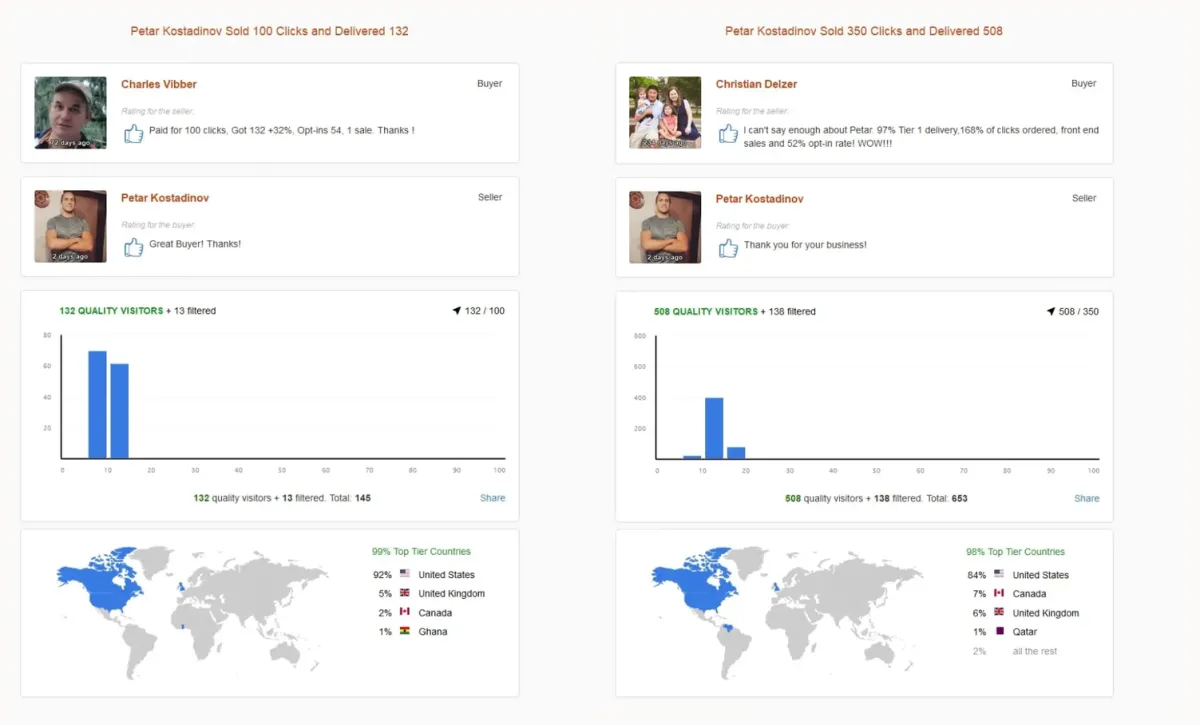
- A real delivery report from a recent order: clicks ordered versus delivered, unique versus raw, and the country breakdown. Vague screenshots of "traffic" don't count.
- Reviews that state numbers. "Great seller, A+" is noise. "200 clicks, 110 opt-ins, 4 sales" is evidence. I keep 400+ written reviews with screenshots on my testimonials page precisely so buyers can check the pattern, not one cherry-picked result.
- How long they've been selling. Scammers churn identities. A seller trading under the same name since 2012 has 14 years of reputation to lose on your $28 order — that asymmetry protects you.
- Clear terms. Read the refund policy before ordering, not after. Mine, for instance, doesn't cover orders where the buyer's own link didn't work — which is also why I test every link before sending.
And run your own tracking link alongside the seller's numbers. An honest seller will never object; a dishonest one will.
The Math: How to Judge Whether a Solo Ad Was Worth It
Most buyers judge a solo ad by the wrong number. Cost per click tells you what you paid; it says nothing about what you got. Immediate sales are the other trap — front-end conversions on cold traffic are rare in every paid channel, and a run with zero day-one sales can still be excellent.
The number that matters is cost per subscriber: what you paid, divided by the opt-ins you collected. Subscribers are what you keep. They receive your follow-up emails for months, and that's where affiliate offers actually convert.
A real example from my archive. Karim bought a run of 125 clicks and collected 97 subscribers. At my pricing of $0.23–$0.28 per click, those 125 clicks cost roughly $29–$35 — call it about 30 to 36 cents per subscriber. He also reported a $37.23 commission from the initial send, meaning the front end alone roughly paid for the traffic, and the 97 subscribers were effectively free. That's the shape of a good outcome: the email list pays going forward, and any immediate sale is a bonus that offsets the spend.
For benchmarks: across the 23 written reviews on my wall that state their results, the median opt-in rate is 43%, with a range from 17% to 83%. If you're converting below roughly 20% on solid tier-1 clicks, the problem is usually the squeeze page, not the traffic — before blaming the seller, test a simpler page with one headline and one form. My solo ads traffic guide covers what to fix first.
What Buyers Actually Report
Averages are useful, but real orders are more instructive. Three from my reviews archive, numbers verbatim:
Josh ordered 191 clicks and received 194, 99% of them top-tier. He collected 100 opt-ins — a 52% rate — and closed 3 sales on the initial run. Textbook result: subscriber cost well under a dollar, front end partly funded by immediate sales.
Leif spent $38, converted 50% of his clicks into opt-ins, and one of those subscribers took a $97/month recurring offer. That single sign-up will out-earn the ad spend many times over — a reminder that with recurring offers, one right subscriber changes the whole equation.
Michael is the case I show to skeptics, because his numbers are ordinary. On his second run he saw a 28.5% opt-in rate — below my median — and still closed 11 sales, because his follow-up sequence did the selling that the landing page didn't. Mutiara's order tells the same story from another angle: 34% opted in, and a third of those subscribers went on to take her CPA offer.
None of this makes solo ads magic, and nobody honest will guarantee you sales — I don't. What the numbers do show is that the "solo ads are dead" framing collapses when buyers publish their reports instead of anecdotes. If your niche fits and your funnel captures emails, solo ads remain one of the cheapest ways to put real tier-1 subscribers on a list. Read the reviews first, start with a small test order, do the cost-per-subscriber math on your own tracker — and only then scale. When you're ready, the order page is here.
For the full price breakdown with documented numbers, see how much solo ads cost.
Before your first order: a five-point pre-flight check
Most disappointing first orders fail before the traffic ever arrives. Run this check before paying anyone:
- An opt-in page, not a sales page. The click has one job: capture the email. Selling happens later, from your list.
- A follow-up sequence already written. Five to seven messages, loaded into your autoresponder, tested on yourself.
- Tracking in place. At minimum, a link that counts unique clicks independently of the seller's report.
- A small first order. 100 to 200 clicks is enough to measure your opt-in rate; my smallest package is 100 clicks for $28.
- A number you'll judge by. Decide in advance: cost per subscriber, not sales on day one.
Ten minutes of preparation is the difference between a test that teaches you something and money that just disappears.
All the measured numbers on this page — opt-in distribution, over-delivery, pricing — live with methodology on the solo ads benchmarks page.
Frequently asked questions
What are solo ads and how do they work?
Are solo ads worth it?
Are solo ads legit or a scam?
Do solo ads still work in 2026?
Who should use solo ads?
What results should I expect from a solo ad?