How solo ads generate a lead for affiliate marketing?
Solo ads fit affiliate marketing because they do the one thing affiliates struggle with: filling an email list fast. A click costs $0.23–$0.95, a decent squeeze page converts 25–45% of those clicks into subscribers, and the affiliate commissions come from the follow-up sequence. Here is the full path from click to commission, with real numbers.
Solo ads are the fastest list-builder an affiliate can buy: at $0.23–$0.28 per click and 43% median opt-in, a $100 order lands you roughly 170 subscribers to promote to — again and again.
Start with a small order →Why Solo Ads and Affiliate Marketing Fit Together
I've been selling solo ads since 2012, and affiliates have always been my biggest group of buyers. There's a simple reason for that, and it comes down to what an affiliate actually owns.
You don't own the product. You don't own the sales page. You don't own the checkout, the pricing, or the refund policy. The vendor can change any of it tomorrow, and networks can close your account without asking. The only asset an affiliate truly owns is the email list. Everything else is rented.
That's why the math of affiliate marketing is really list-building math. A click on your affiliate link is worth something once. A subscriber on your list can be mailed the same offer next week, a different offer next month, and a launch six months from now. The affiliates I've watched succeed over fourteen years all think in cost per subscriber, not cost per click — because the subscriber is the thing that keeps paying.
Solo ads fit this model better than almost any other traffic source, because the traffic already behaves the way you need it to. My list was built organically from people interested in making money online, and they're used to reading emails and clicking links inside them. You're not trying to convert a cold social-media scroller into an email reader. You're moving an email reader from my list onto yours. That's a much shorter jump.
The honest flip side: solo ads do not produce instant riches, and anyone who tells you they do is selling you something. What they produce, reliably, is subscribers. Whether those subscribers turn into commissions depends on the offer you pick and the emails you send afterwards. This article walks through the whole chain, with real numbers from my own buyers at every step.
The Full Path: Click, Opt-In, Email, Commission
A lot of guides hand-wave this part, so let me lay out exactly what happens between the moment I hit send and the moment a commission lands in your affiliate account.
- The click. I write the ad email myself (you approve the copy before it goes out — this is included on every order), and I mail it to my list. Traffic starts within 24 hours. Someone on my list reads it, clicks, and lands on your page. About 95% of these clicks come from tier-1 countries: US, UK, Canada, Australia, New Zealand.
- The opt-in. Your page should be a squeeze page — a headline, a promise of a freebie (a checklist, a short guide, a video), and one email box. Nothing else. The median opt-in rate my buyers report in written reviews is 43%, so from 100 clicks you can reasonably plan for around 40 new subscribers, more if your page is tight.
- The welcome email. Your autoresponder fires immediately: it delivers the freebie, tells the subscriber who you are, and sets the expectation that more emails are coming. This email gets the highest open rate you will ever see from that subscriber, so it should also contain your first soft mention of the affiliate offer.
- The sequence. Over the next five to seven days, a pre-written email series builds the case for the offer — the problem, your angle on it, proof, and the pitch. This is where the actual selling happens, and I'll break the structure down further below.
- The commission. Somewhere in that sequence, a subscriber clicks your affiliate link warm — already knowing you, already sold on the idea — and buys. The vendor's sales page closes a warm reader far more often than it closes a cold click.
Notice where your affiliate link sits in this chain: at the end, inside your emails. Not on the page the solo ad traffic lands on. That single structural choice is the difference between affiliates who make solo ads work and affiliates who burn a budget and leave a one-star review somewhere.
Choosing Affiliate Offers That Convert on Email Traffic
Not every offer works on solo ad traffic, and I'd rather tell you that before you order than after. Two filters matter: niche match and price structure.
Niche match
My list responds to four niches: Make Money Online, Internet Marketing, Business Opportunity, and Health & Fitness. If your offer is in one of those, the traffic fits. If you're promoting gardening tools, drone accessories, or local dentist software, don't buy from me — the list won't care, and no volume of clicks fixes a mismatch. Facebook or Google will serve you better there; I've written an honest comparison in solo ads vs Google Ads vs Facebook Ads.
Price structure
Email subscribers who joined your list yesterday rarely buy a $997 course on day two. What they do buy is low-ticket front-end offers — typically under $50 — that lead into a bigger back-end. The ideal shape is a cheap entry product with either upsells or, better, a recurring subscription behind it.
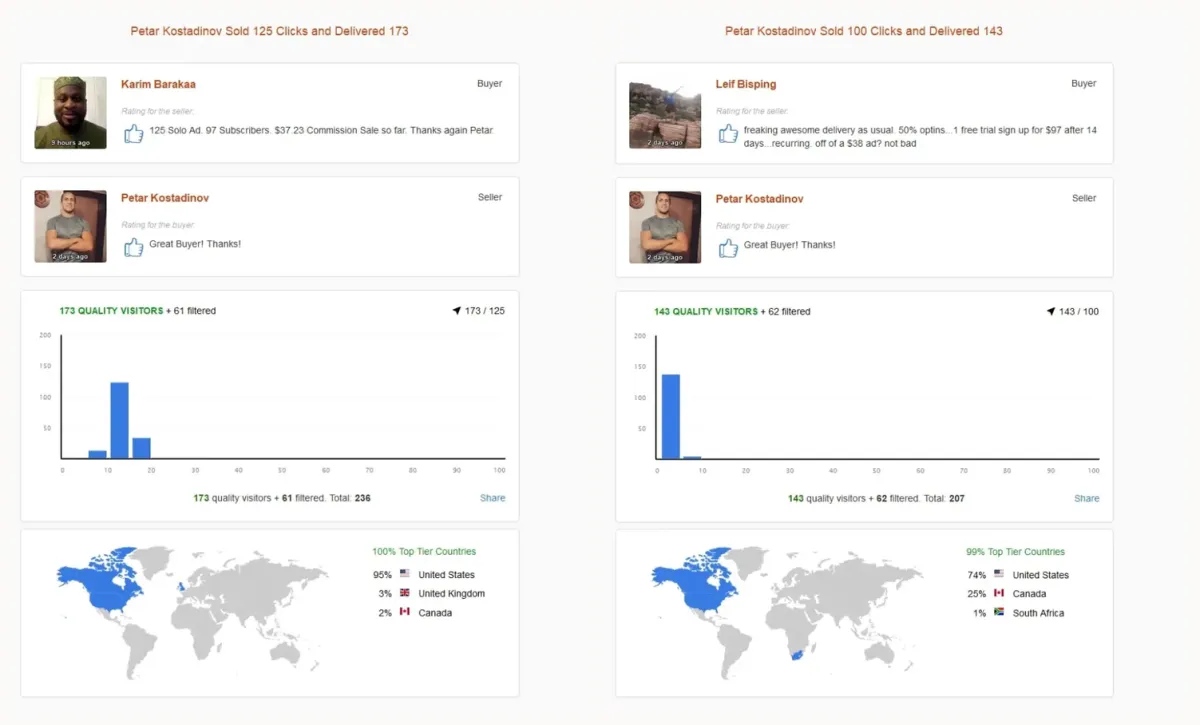
One of my buyers, Leif, is the cleanest example I can give you. He spent $38 on a small order, got a 50% opt-in rate, and one of those subscribers signed up for a $97/month recurring program he was promoting. One sign-up. If that member stays six months, a $38 ad spend returned several hundred dollars in commissions — and every other subscriber from that order is still on his list, still receiving emails, still capable of buying something else. That's the recurring back-end doing the heavy lifting, not the traffic.
So when you evaluate an offer, ask three questions. Does it match one of the four niches above? Is the front-end cheap enough for a new subscriber to say yes within a week? And is there a back-end — recurring billing, upsells, a product ladder — that lets one buyer be worth more than one commission? Offers that pass all three are the ones my buyers report results with.
The Real Numbers: What Buyers Actually Report
Most articles about solo ads for affiliate marketing invent a hypothetical funnel with round numbers. I don't need to, because my buyers write reviews with their actual results, and there are over 400 of them with screenshots on my testimonials page. Here are four documented cases that show the realistic range.
| Buyer | Clicks | Subscribers | Early result |
|---|---|---|---|
| Karim | 125 | 97 | $37.23 in commissions in the first days |
| Aldona | 200 | 110 | 4 sales |
| Mutiara | — | 34% opt-in rate | 33% of subscribers took her CPA offer |
| Michael | second run | 28.5% opt-in | 11 sales |
A few things worth reading out of that table honestly. Karim's $37.23 in the first days did not cover his order by itself — but he banked 97 subscribers who cost him nothing further to mail, and the sequence keeps working after the review was written. Aldona's 110 opt-ins from 200 clicks is a 55% opt-in rate, well above my buyers' 43% median, which tells you her squeeze page was doing its job. Mutiara's case shows what happens when the offer matches the traffic: a third of her new subscribers took the CPA offer she put in front of them. And Michael's 11 sales came on a second order — his first run built the list, his rerun and follow-up converted it, which is exactly the pattern I keep telling first-time buyers to expect.
I want to be equally clear about what these cases are not. They are not guarantees, and they are not averages — they're individual reports, and the full review archive includes buyers who got subscribers but no sales in week one. Traffic sellers who promise sales are lying to you, because no seller controls your page or your offer. What I can document is the click quality and the opt-in rates; the reviews show what buyers did with them.
Budgeting: What $100 to $300 Actually Buys
My packages run from 100 clicks for $28 up to 2,000 clicks for $550, which works out to $0.23–$0.28 per click depending on size. Every order also gets 20% over-delivery as standard — buyers have documented runs of 194 clicks delivered on a 191-click order, 257 on 191, and one run at 133% delivery — so the real cost per click lands lower than the sticker price.
Here's what the common budget tiers translate to, using the 43% median opt-in rate my buyers report:
- $78 (300 clicks): around 360 clicks delivered with over-delivery, roughly 150 subscribers. About $0.52 per subscriber.
- $125 (500 clicks): around 600 delivered, roughly 260 subscribers. About $0.48 per subscriber.
- $230 (1,000 clicks): around 1,200 delivered, roughly 500 subscribers. About $0.46 per subscriber.
Your own number will move with your squeeze page — the documented range in my reviews runs from 17% to 83% opt-in — but this is the arithmetic to plan around. If your page converts at 43% and a subscriber costs you fifty cents, then the question "can I profit with solo ads?" becomes a concrete one: can your email sequence and your offer's commission structure earn more than fifty cents per subscriber over the subscriber's lifetime? With a recurring back-end like Leif's, one $97/month sign-up answers that question for an entire order.
My advice on scaling has not changed in fourteen years: start small, measure, then scale what worked. A 300-click first order is enough to read your opt-in rate with reasonable confidence. If the rate is healthy, reorder bigger with the same page. If it's under 25%, the traffic isn't the variable to change — fix the page first, because doubling the budget on a leaking page just doubles the leak. When you're ready, the packages are listed on the order page, and if you want to compare direct buying against marketplace pricing first, my Udimi review covers the trade-offs — marketplace sellers there list at $0.35–$0.95 per click, plus a $19.95/month Prime membership if you want the extras.
The Follow-Up Sequence That Does the Selling
If the squeeze page determines your cost per subscriber, the email sequence determines your revenue per subscriber. This is the part most first-time buyers under-build, and it's why day-3-to-7 results routinely beat day-0 results.
A working five-to-seven email sequence looks something like this:
- Email 1 (immediately): deliver the freebie, introduce yourself in three sentences, and add one line about the offer with a link. No hard pitch.
- Email 2 (day 1): the problem. Describe the frustration your subscriber signed up to solve, in their words. Link again, still soft.
- Email 3 (day 2): your story or angle — why you use or recommend this specific product over the alternatives.
- Email 4 (day 3): proof. Results, a case, a demo. This is usually the first email where the pitch is direct.
- Emails 5–7 (days 4–7): objections, a deadline or bonus if you have one, and a plain last-call email.
Why does day 3–7 outsell day 0? Because on day 0 the subscriber knows nothing about you — they clicked an ad and grabbed a freebie. By day 4 they've opened three or four of your emails, they recognize your name in their inbox, and the offer has been framed, justified, and proven before they ever see the vendor's sales page. A warm reader clicking through email 4 converts in a way a cold day-0 click simply doesn't. Mutiara's 33% of subscribers taking her CPA offer didn't happen on the landing page; it happened in the inbox.
All of this requires an autoresponder — a tool that sends the sequence automatically to each new subscriber. If you don't have one yet, I've compared the two I see my buyers use most in my AWeber vs GetResponse review. Set the sequence up completely before you order traffic, not after. Clicks start arriving within 24 hours of your order, and a subscriber who hears nothing for three days is a subscriber going cold. One more practical note: affiliate emails in the US fall under FTC disclosure rules, so say plainly that you earn a commission — the FTC's endorsement guides spell out what's expected, and disclosure honestly doesn't hurt conversions with this audience.
Mistakes That Burn Affiliate Budgets
After fourteen years of watching buyers succeed and fail with the same traffic, the failures cluster into four patterns.
Direct linking. Sending solo ad clicks straight to an affiliate sales page, with no opt-in step, is the most expensive mistake on this list. The visitor either buys in that one visit or is gone forever, and cold visitors almost never buy in one visit. You paid for a click and kept nothing. Every case in this article — Karim's, Leif's, Aldona's, Michael's — ran through a squeeze page first.
Judging the campaign on day-0 sales. If you check your affiliate dashboard the evening your traffic runs and declare the campaign dead, you've measured the wrong thing at the wrong time. The right day-0 metric is opt-in rate. Sales are a day-3-to-7 metric, and with recurring offers the honest accounting window is months, not hours.
No autoresponder in place. Some buyers collect the subscribers and then... mail nothing, or mail once manually and stop. The list is the asset, but only if it hears from you. An unmailed list decays into strangers within weeks.
One-and-done buying. A single small order is a test, not a campaign. Michael's 11 sales came on his rerun; the buyers who show up in my reviews with the strongest results are almost all repeat buyers who tested small, fixed what the first run exposed, and reordered. One order builds the start of a list. Consistent orders build the asset that pays you every month.
Avoid those four, match the offer to the niche, and let the sequence do the selling. That's the whole system — no secrets held back. If you're new to solo ads generally, start with my beginner's guide to solo ads traffic; when you're ready to test it with your own funnel, I write the ad copy for you and traffic starts within 24 hours.
Promoting ClickBank offers specifically? See the ClickBank solo ads guide.
From click to commission: the math at each stage
Three documented orders from my archive, traced through the same funnel stages:
- Karim: ordered 97 clicks, received 125, and reported a $37.23 commission on the campaign. The order roughly paid for itself while the subscribers stayed on his list.
- Aldona: 200 clicks in, 110 subscribers captured, 4 sales from the follow-up sequence. The 55% opt-in did the heavy lifting.
- Leif: a $38 order that produced one $97/month recurring sign-up. A single subscriber now out-earns the whole campaign every month.
The pattern across all three: the click bought the subscriber, and the sequence made the money. Plan your offer so one of those two stages can carry the campaign, and the other becomes a bonus.
Frequently asked questions
How do solo ads work for affiliate marketing?
Are solo ads good for affiliate beginners?
Which affiliate offers convert with solo ad traffic?
What opt-in rate should I expect?
How much should an affiliate budget for solo ads?
Do I need my own product to use solo ads?