ClickBank Solo Ads: Can You Actually Profit?
Yes, you can profit promoting ClickBank offers with solo ads — but only with an opt-in page and an email sequence between the click and the offer. Send solo traffic straight to a hoplink and you will almost certainly lose money. I've sold solo ads since 2012, and the buyers of mine who profit on ClickBank all run the same simple funnel. Here's how it works and what the numbers look like.
Yes — with an opt-in page and a follow-up sequence. No — if you direct-link a hoplink and hope. One documented buyer turned a $38 order into a $97/month recurring sign-up; the difference was the funnel, not the traffic.
Start with a small order →The straight answer
Can a beginner with no website and no social following make ClickBank sales from solo ads? Yes — I've watched buyers of mine do exactly that, and I'll show you their numbers below. But the "yes" comes with one non-negotiable condition: you capture the email address first, then promote the offer to your new subscribers over days and weeks.
The version that fails is the one most beginners try first: paste your ClickBank hoplink into the ad, buy clicks, and hope. That approach loses money for three reasons. First, cold subscribers almost never buy on the first visit — they clicked a link in someone else's email out of curiosity, not with a credit card in hand. Second, when the visitor leaves the vendor's sales page without buying, you have nothing. No email, no second chance, no asset. You paid for a click and it evaporated. Third, ClickBank vendors' sales pages are long — video sales letters, twenty-minute pitches — and cold traffic rarely sits through them. Warm traffic does.
So the honest framing isn't "do solo ads work for ClickBank" — it's "are you willing to build a two-page funnel and write a follow-up sequence." If yes, solo ads are one of the fastest ways to test a ClickBank offer, because you can buy targeted email traffic today instead of waiting months for SEO or fighting ad-platform review teams. If no, keep your money.
Why email traffic suits ClickBank offers
ClickBank's catalogue is built for exactly the kind of traffic a solo ad delivers. Most front-end offers are impulse-priced — $17, $27, $37 — which is a decision a warmed-up subscriber can make from a phone. And the real margin usually isn't in the front end at all: it's in upsells and recurring back-ends, where a single membership sign-up can out-earn twenty one-time sales.
A buyer of mine named Leif is the cleanest example I have. He spent $38 with me — my smallest package territory — got a 50% opt-in rate on his squeeze page, and his follow-up emails produced one sign-up to a $97/month recurring program. One subscriber, one sale, and the order paid for itself several times over in the first month, before counting anything the rest of his new list buys later. Karim, another buyer, took 125 clicks, captured 97 subscribers, and earned a $37.23 commission from his sequence — roughly break-even on the traffic, with 97 people still on his list to mail tomorrow.
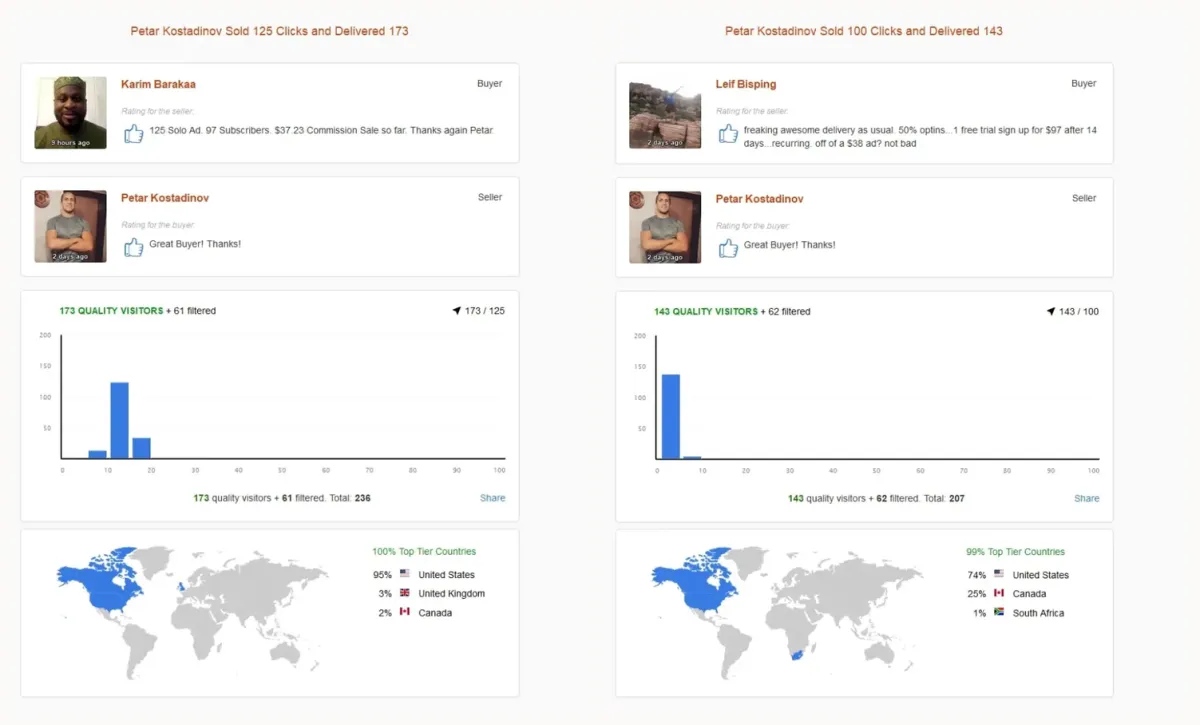
Notice what both cases share: the sale came from the emails, not the first visit. That's the pattern across the 400+ written reviews buyers have left me. The click starts the relationship; the sequence closes it. If you want the mechanics of how a solo click becomes a lead in the first place, I've written that up separately in how solo ads generate a lead for affiliate marketing.
The bridge-page funnel, step by step
Here is the funnel my profitable ClickBank buyers run. It's two pages and an autoresponder — nothing you can't build in an afternoon.
- Opt-in page. One headline, one promise, one email box. Give away something genuinely useful and tightly related to the offer — a checklist, a short guide, a case study. No navigation, no distractions. My buyers report a median 43% opt-in rate on pages like this.
- Thank-you / bridge page. This is where most beginners leave money on the table. Instead of dumping the new subscriber onto the vendor's page cold, the bridge page is you talking for sixty seconds: who you are, why you recommend this product, what it did for you or for people like your reader. Then the button to the offer. It pre-sells, and it's also where your affiliate disclosure lives.
- The offer. Your hoplink, opened from the bridge. Some percentage buys now. Most don't — and that's fine, because of step four.
- The sequence. Five to ten emails over two weeks. Value, story, proof, offer, deadline. This is where Leif's $97/month sign-up came from and where Karim's commission came from. Here's the part beginners miss: a ClickBank vendor's sales page converts noticeably better on the third or fourth exposure than on the first, because by then your subscriber has context, trust, and a reason to go back. The same page that bounced them cold closes them warm.
You'll need an autoresponder for step four; if you're choosing one, my AWeber vs GetResponse comparison covers the two I see buyers use most.
Picking a ClickBank offer that fits solo traffic
Beginners usually sort the ClickBank marketplace by gravity and grab the top result. Gravity is worth a glance, but it isn't a conversion rate — it's a rough count of distinct affiliates who recently made sales. A gravity of 300 mostly tells you the offer is crowded: every subscriber you send has likely seen it in five other people's emails this month. I'd rather promote a solid offer with moderate gravity than fight for scraps on the most saturated one.
What actually matters for solo traffic:
- Front-end price fit. Fresh email subscribers buy at $17–$47 far more readily than at $197. High-ticket offers can work from a list, but weeks later, not in week one.
- Recurring or strong upsell path. Leif's economics only work because the product bills monthly. A $27 one-time commission has to be sold over and over; a $97/month sign-up keeps paying while you sleep.
- Niche match with the traffic. My list responds to Make Money Online, Internet Marketing, Business Opportunity, and Health & Fitness offers. A woodworking-plans product, however good, is the wrong fit for my traffic — I'll tell you so before you order.
- Refund reality. ClickBank gives customers a 60-day money-back guarantee, and it's famously easy to use. That means a commission you "earned" today can be clawed back for two months. Hype-heavy offers that convert well often refund heavily too, and the refund rate quietly rewrites your math: a campaign that looks profitable on day 7 can turn break-even by day 60. Favor products that deliver what the sales page promises, and don't judge a campaign's profit until the refund window has mostly passed.
The numbers to plan around
Across 23 written reviews from my buyers that state their results, the median opt-in rate is 43% (the range runs 17% to 83%, mostly driven by page quality and offer match). My packages run from 100 clicks for $28 to 2,000 for $550, which works out to $0.23–$0.28 per click, with 95% tier-1 traffic and 20% over-delivery standard on every order.
That gives you a planning number that matters more than cost per click: cost per subscriber. At $0.28 a click and a 43% opt-in rate, you're paying about $0.65 per subscriber. For comparison, on a marketplace like Udimi — where sellers list at $0.35–$0.95 per click — the same 43% opt-in rate puts you between $0.81 and $2.21 per subscriber. I've broken down the marketplace trade-offs in my Udimi review; escrow protection there is real, and for a first-ever purchase from an unknown seller it has value. The math above is simply what you're paying for it.
How much do you need to find out whether your funnel works? Less than most people think. A $78 order (300 clicks, and with over-delivery you'll typically see more) at median opt-in puts roughly 120–130 people onto your list — enough to see your opt-in rate clearly and to watch how the sequence performs. Around $100 is a genuine test, not a token one. What it will not tell you by day 3 is your profit: with an impulse front-end plus a recurring back-end, revenue arrives over weeks. Judge the opt-in rate immediately, judge the money after the sequence has run and the refund window has cooled. My solo ads traffic guide goes deeper on reading test results.
Mistakes that burn ClickBank budgets
After fourteen years of watching buyers succeed and fail with the same traffic, the failures cluster into four patterns.
Direct linking the hoplink. The single biggest one, covered above, but it bears repeating because it's tempting: no page to build, results "today." What you actually get is a list of zero and, usually, no sales. Every click you send without capturing the email is inventory you bought and threw away.
Judging the campaign on day 0. One blogger at wealthanize.com (October 2020) documented three MLM campaigns with 46.9% and 44.5% opt-in rates, made zero sales, and concluded solo ads don't work. Read his own numbers again: the traffic did its job — nearly half of clicks became subscribers. What sold nothing was the follow-up. That's not a traffic verdict, it's a sequence verdict, and it's the most common way a genuinely working campaign gets written off as a failure.
Buying cheap, unknown traffic. $10-for-1,000-clicks gigs on freelance marketplaces are priced that way because the "clicks" are bots or incentivized junk. It will inflate your click count, crater your opt-in rate, and poison your list with addresses that never open. Whoever you buy from — me or anyone else — look for a public track record with screenshots and named results, not a price tag. I keep a list of vetted providers if you want to compare options.
Skipping the disclosure. If you're earning commissions, the FTC requires you to say so clearly and conspicuously — on your bridge page and in your emails, not buried in a footer. The FTC's endorsement guides spell it out. A one-line "I earn a commission if you buy through my link" costs you nothing in conversions and keeps you out of trouble.
If you're brand new to this traffic source, start with my beginner's guide to solo ads, build the two-page funnel, and run a small test before you scale anything.
Matching a ClickBank offer to solo ad traffic
Solo ad clicks are email readers in the make-money and self-improvement niches. Some ClickBank offers fit that traffic; many don't. Check three things before promoting:
- A recurring back-end. One documented $38 order on my list produced a $97/month recurring sign-up. One-time $17 commissions rarely survive the math; continuity offers can.
- An offer that sells by email. Long video sales letters convert poorly on cold first clicks; offers with strong email swipes are built for the follow-up sequence, where solo ad sales actually happen.
- Your page in front of it. Opt-in first, offer second. Sending paid clicks straight to a ClickBank checkout leaves you with nothing when the campaign ends.
Frequently asked questions
Can a beginner make ClickBank sales with solo ads?
Do I need a website to promote ClickBank with solo ads?
Should I direct link to the ClickBank offer or use a landing page?
How much money do I need to start?
Why did I get opt-ins but no sales?
How do ClickBank refunds affect my profit?