Best Solo Ads Providers

Most "best solo ads providers" rankings are affiliate pages — they rank whoever pays the biggest commission, with no test orders behind the list. The honest answer: the best provider is the one with documented deliveries in your niche. Here is how to compare providers on evidence, and where my own service fits.
The best solo ads provider is measurable, not famous: demand delivery reports, tier splits and named reviews before money moves — from me included.
My documented numbers →Related: the full Udimi review from a rival seller — what the marketplace costs and when it wins.
Why Every "Best Solo Ads Providers" List Disagrees With Every Other One
Search this exact phrase and open the top five results side by side. The rankings barely overlap. Provider A is number one on one page, absent from the next, and "avoid at all costs" in a forum thread from the same month. That should bother you.
Here is what is actually happening. Most ranking pages are affiliate pages. The order of the list is decided by commission rates, not by test orders. The writer has never bought a click from anyone on the page. There is no methodology section, because there is no methodology — nobody ran the same funnel through five sellers and compared the reports. When placement is for sale, the ranking is an ad, and you should read it the way you read any ad: as a claim someone was paid to make.
I sell solo ads myself, so I have an obvious interest here too. I am not going to pretend otherwise. What I can do instead is give you the evidence standard I would use if I were buying, apply it to the whole market including my own service, and let you check every number I state. A ranking can lie to you. A verification method cannot, because you run it yourself.
One thing I will not do on this page is hand you a numbered top-ten. The honest answer to "who is the best solo ads provider" is: the one with documented deliveries in your niche, at a price the math supports, verified by you with a small test order. The rest of this page shows you how to find that seller.
The Evidence Standard: What a Provider Must Show Before Any Money Moves
Before you send a single dollar, a seller should be able to put four kinds of evidence in front of you. Not promises. Evidence.
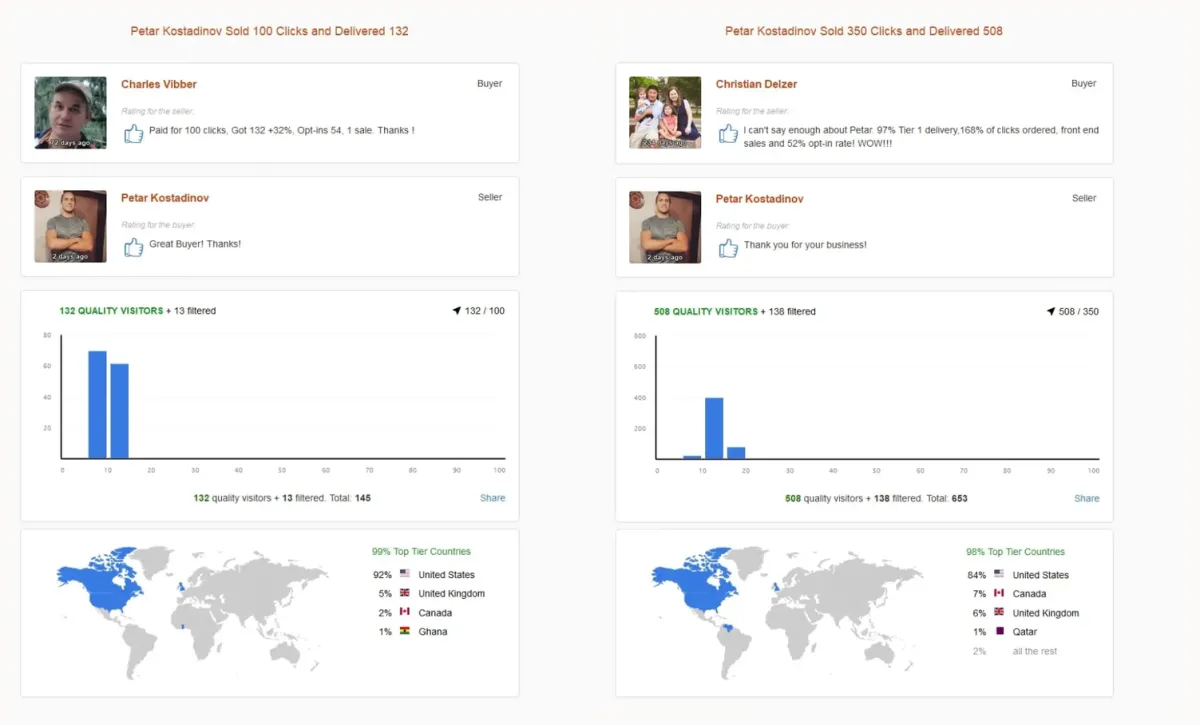
Documented deliveries. Screenshots or reports from actual completed orders — clicks ordered, clicks delivered, dates. A seller who has been mailing for years has hundreds of these. A seller who dodges the request has a reason to dodge it.
Named reviews with numbers in them. "Great seller, fast delivery, A+++" tells you nothing. A review worth reading says what was ordered, what arrived, and what happened next: opt-ins, and ideally sales. Reviews with numbers can be checked against each other. Reviews without numbers are decoration.
A tier-1 breakdown. Where do the clicks come from? Traffic from the US, UK, Canada, Australia and New Zealand behaves very differently from traffic elsewhere, and it costs more to generate. A seller who won't state a tier-1 percentage — or won't show it in delivery reports — is usually selling you a percentage you wouldn't pay for if you knew it.
An over-delivery record. Serious sellers send more clicks than you ordered, as a buffer against bots and accidental clicks. It costs them almost nothing and tells you a lot: a seller who consistently over-delivers is a seller whose list is big enough and responsive enough that extra clicks are cheap. Ask what their standard is, then look for it in the delivery screenshots.
Notice what is not on this list: guaranteed sales. No honest seller guarantees sales, because sales depend on your offer and your funnel, which the seller does not control. A provider who promises sales is either lying to you or planning to send fake conversions. Treat the guarantee itself as a red flag. I've written more about how the click-to-sale chain actually works in my solo ads traffic guide.
Where to Actually Look for Providers
There are three places sellers live, and each involves a trade-off.
Marketplaces
Udimi is the big one. Sellers there list at roughly $0.35–$0.95 per click, the minimum order is 50 clicks, and the platform holds your money in escrow until delivery is confirmed — which genuinely matters when you are testing a stranger. The trade-offs: prices carry the platform's cut, the optional Prime membership runs $19.95 a month, and the review system rewards volume and politeness more than results, so you still have to dig for reviews that state numbers. I've written a full breakdown in my Udimi review, including where I think the platform is the right choice and where it isn't.
Direct sellers
Buying direct means no escrow and no middleman fee. You are trading platform protection for price and for a direct relationship with the person who owns the list. That trade only makes sense when the seller's track record is long enough and public enough to substitute for escrow — which is exactly why the evidence standard above exists. A seller with years of documented deliveries and hundreds of written reviews has more to lose from burning you than they could possibly gain. A seller with a two-month-old site and no reviews should be bought through a marketplace or not at all. I cover the direct-buying process step by step in how to buy solo ads.
Communities and referrals
Facebook testimonial groups, forum threads, word of mouth from other list builders. Signal quality varies wildly — some "testimonials" in those groups are sellers reviewing themselves — but a specific, unprompted recommendation from someone in your niche who shows their own numbers is worth more than any ranking page, including this one.
The Comparison Protocol: How to Test Providers Fairly
Once you have two or three candidates who pass the evidence check, stop reading and start testing. Rankings end here; data begins.
- Same funnel for every seller. One squeeze page, one offer, one follow-up sequence. If you change the funnel between tests, you can no longer tell whether the difference was the traffic or the page.
- Same week. Run the tests as close together as you can. A test in January and a test in April are not comparable — offers fatigue, seasons shift, your own page changes.
- 100 clicks per seller. Small enough to be cheap, large enough that the opt-in rate means something. Fifty clicks is noise. A thousand is an unnecessary bet on an unproven seller.
- Separate tracking links per seller. Your tracker's numbers, not the seller's. You are comparing what arrived, not what was promised.
- Compare four numbers from the reports: clicks delivered versus ordered (did they over-deliver?), tier-1 percentage, opt-in rate, and cost per subscriber. Cost per subscriber — what you paid divided by opt-ins — is the number that decides the rematch. A $0.60 click at a 50% opt-in beats a $0.30 click at a 20% opt-in.
Then reorder with the winner and watch whether the second run holds up. A good list performs consistently. A recycled or bot-padded list often looks fine on run one and collapses on run two, because the fresh segment was spent on impressing you.
My Own Numbers, for the Record
I said I would apply the standard to myself, so here it is. Judge it exactly the way you would judge anyone else on your shortlist — and then test it the same way.
| Claim | The number | Where to verify |
|---|---|---|
| Price per click | $0.23–$0.28 depending on package size | Package list on the order page |
| Tier-1 traffic | 95% (US, UK, Canada, Australia, NZ) | Delivery screenshots in reviews |
| Over-delivery | 20% standard on every order | Documented runs: 194 delivered on 191 ordered, 257 on 191, one 133% run |
| Opt-in rate | 43% median across the 23 written reviews that state a result (range 17%–83%) | Each review, with screenshots, at /testimonials/ |
| Track record | Selling since 2012; one list, built organically, mailed daily; 400+ written reviews | Testimonials archive |
Context those numbers honestly. My list fits Make Money Online, internet marketing, business opportunity, and health & fitness offers. If you sell outside those niches — local services, e-commerce in an unrelated category, B2B software — my traffic is the wrong traffic and I will tell you so before you order. The 43% median is a median, not a promise: the range in those same reviews runs from 17% to 83%, and where you land depends mostly on your squeeze page. And because this is a direct purchase, there is no marketplace escrow; my refund policy is published, and it does not cover orders where your own link was broken, so test your funnel before the traffic starts.
Hold me to the protocol above. Order 100 clicks, run them against any other seller on your shortlist in the same week, and let your tracker pick the winner. That is the whole pitch. If my numbers were weaker than the market's, this would be a very stupid page to publish.
Red Flags: The Short Version
Whoever you end up testing, walk away from any provider who shows these:
- Guaranteed sales or income claims. No seller controls your offer. This is either a lie or fake conversions.
- No numbers anywhere. No tier-1 percentage, no delivery screenshots, reviews that are all adjectives.
- Prices too far below the market with no track record. Cheap clicks from a list nobody has heard of are usually bots or cold, recycled traffic.
- Refusal to answer where the list comes from. How it was built, what niche it is in, how often it is mailed. A real list owner answers in one sentence.
- Pressure to buy big first. Any seller confident in their traffic will happily take a 100-click test order. I've collected more of these patterns in my guide to vetting solo ads vendors.
The best solo ads provider is not a name on a list — mine included. It is whoever survives your 100-click test with the best cost per subscriber in your niche, twice in a row. Demand the evidence, run the protocol, and the ranking writes itself.
Curious how the other side works? How solo ad sellers actually operate.
Scoring any provider in ten minutes
Before money moves, score the provider on four things you can verify from your chair:
| Check | Pass | Fail |
|---|---|---|
| Recent delivery report | Sent within minutes, numbers visible | Stalling, cropped screenshots |
| Named, dated reviews | Real names, recent dates, specifics | Anonymous praise, no dates |
| Straight answer on list source | Own funnels, named niches | "Various partners" |
| Price sanity | Within the documented $0.23–0.95 range | Far below it |
Four passes: order a 100-click test. Any fail: the ranking page that recommended them was paid to.
Frequently asked questions
Who are the best solo ad providers?
Is Udimi a good place to find providers?
How do I compare two solo ads providers?
What separates a top provider from an average one?
Why do provider rankings differ so much between sites?
What do your own delivery numbers look like?