How to Start a Solo Ad Business (From a Seller of 14 Years)
To start a solo ad business you need one thing before anything else: an email list that produces 50–100 clicks per day, every day, without being squeezed. Build it organically, mail it daily, prune it hard. Then learn the unglamorous parts — click filtering, scheduling, over-delivery, refunds, deliverability — because those decide whether you last fourteen years or fourteen weeks. I've done the former, on a single list, since 2012.
Before you sell a single click you need a list that produces 50–100 clicks a day, every day. Everything else — pricing, filtering, over-delivery, reputation — is built on that. Here's the operational reality nobody who hasn't run one can tell you.
What my archive looks like →The honest prerequisite: capacity, not ambition
Most guides on selling solo ads are written by people who have never sold one. They run hypotheticals — 50,000 subscribers times a 1% click rate — and the arithmetic looks easy. Real capacity is what your list actually produces when you mail it on a normal Tuesday, and the old forum rule of thumb is roughly right: you want 50–100 clicks per day of consistent output before you take money from anyone.
Why that number? Because the smallest order a buyer will realistically place is 50–100 clicks, and you need to fill it in a day or two without hammering the same subscribers with the same link five times. If filling one small order takes your whole week, you have a hobby list, not inventory.
Selling too early is the fastest way to end your career before it starts. A seller with thin capacity either delivers late, delivers junk clicks to hit the number, or mails the list into the ground. All three produce angry public reviews, and in this business the reviews are the storefront. I have watched sellers burn a year of list building in a month of over-selling. There is no undo button on a reputation.
Building the asset
The list is the business. Everything else — the sales page, the tracker, the pricing table — is decoration around it. Two decisions matter most.
Organic opt-ins, not bought data. People who chose to join your list click, subscribe to your buyers' offers, and occasionally buy. Purchased or scraped addresses do none of that, and they poison your sender reputation on top. Every good click I have ever delivered came from someone who opted in to hear from me. If you want the mechanics of how those clicks turn into a buyer's leads, I walked through the whole chain in how solo ads generate a lead for affiliate marketing.
Daily mailing is maintenance, not just selling. I mail my list every day whether or not there is a paid order to send. Daily contact keeps the list responsive, keeps my sending domain warm, and tells me immediately when engagement slips. A list you only touch when someone pays you goes cold between orders, and cold lists produce exactly the flat, lifeless clicks buyers complain about.
Pruning is the other half of maintenance. Subscribers who haven't opened or clicked in months get re-engagement attempts, then removal. It hurts to delete addresses you paid to acquire, but a smaller list that clicks beats a big list that doesn't — buyers pay for clicks, not for your subscriber count.
My own model is deliberately boring: one list, built organically since 2012, mailed daily, focused on the niches it genuinely fits — Make Money Online, internet marketing, business opportunity, and health & fitness. I have never run parallel lists in niches I don't understand, and I turn away orders for offers my list won't respond to. That single decision has probably done more for my review page than anything else.
The operations nobody writes about
This is the part missing from every course and tool manual I've read, because you only learn it by delivering orders.
Click filtering and bot protection
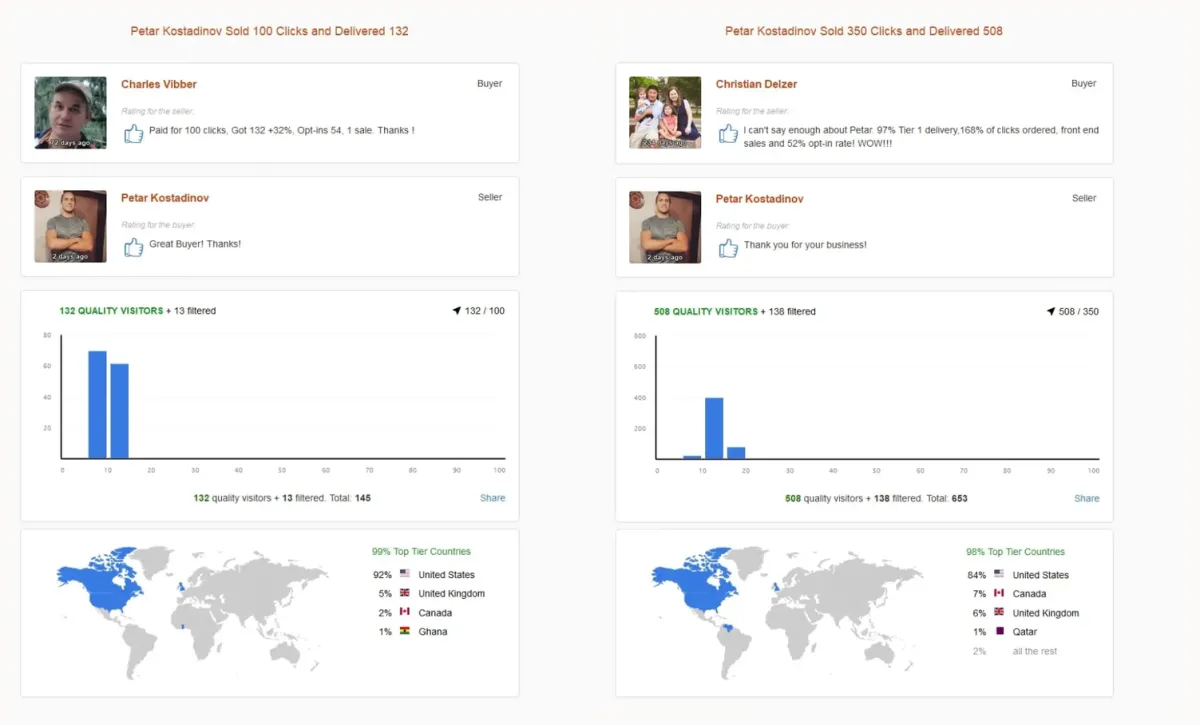
Raw clicks lie. Some are bots, some are the same person tapping twice, some come from countries your buyer didn't pay for. A serious seller runs every order through a tracker that filters obvious bot signatures and duplicates, and reports the filtered number — not the raw one. I sell traffic that is 95% tier-1 (US, UK, Canada, Australia, New Zealand), and I can only say that with a straight face because the tracker proves it per order. Buyers who have been burned elsewhere will ask for the geo report. Have it ready before they ask.
The mailing calendar
Orders don't queue themselves. Each buyer's link needs one or more sends, spaced so the list isn't seeing three different offers in one morning, and each order has a promised start — mine begin within 24 hours. That means keeping an actual calendar: which segment gets which link on which day, where the gaps are, how much daily capacity is already committed. Overbook it and something ships late. This scheduling discipline, not copywriting, is the daily work of a solo ad seller.
Over-delivery as strategy
I promise 20% over-delivery on every order, and in practice I usually send more — across fifteen documented runs on my reviews archive the median came out at +38%. One buyer, Josh, ordered 191 clicks and got 194 before the over-delivery sends even finished; another run on a 191-click order landed at 257; one order shows 133% delivery in the report.
Why give traffic away? Because a solo ad business lives on repeat buyers, and nothing converts a first order into a standing relationship like getting more than you paid for. A buyer who receives 240 clicks on a 200-click order doesn't shop around next month. The extra clicks cost me almost nothing — the list is mailing daily anyway — while a new customer acquired through cold channels costs plenty. Over-delivery is the cheapest marketing a seller has.
Refunds and disputes
Decide your policy before the first dispute, write it down, and publish it. Mine is plain: I don't refund clicks that were delivered to a broken or dead link, because I deliver the traffic and the buyer owns the destination — which is exactly why I check every link before sending and write the ad copy myself for the buyer's approval. Whatever your rules are, ambiguity is what turns a grumble into a public accusation. A published policy plus a delivery report ends most arguments in one email.
Deliverability after the Gmail and Yahoo rules
Since 2024, Gmail and Yahoo require bulk senders to authenticate with SPF, DKIM and DMARC, offer one-click unsubscribe, and keep spam complaint rates under 0.3% — Google publishes the full list in its Email sender guidelines. For a solo ad seller this isn't compliance trivia; it's the plumbing your entire income runs through. A seller whose mail lands in spam has nothing to sell. Authenticate your domain properly, watch complaint rates in Postmaster Tools, and treat a complaint spike as a fire alarm: it usually means you mailed an offer your list hates, and the fix is better offer screening, not a new domain.
Pricing your clicks
Price per click is where new sellers panic. Here is the real market: on Udimi, the biggest marketplace, sellers list between $0.35 and $0.95 per click (I break the platform down in my Udimi review). Selling direct from your own site, you set your own tiers. Mine run from 100 clicks at $28 up to 2,000 at $550 — $0.23 to $0.28 per click, cheaper at volume.
I can price under the marketplace floor because I have no marketplace commission and no ad spend — the review archive brings the buyers. You probably can't start there, and you shouldn't try. Racing to the bottom on price attracts the worst buyers in the niche: the ones running unchecked funnels, filing disputes as a habit, and leaving no review either way. Price mid-market, over-deliver, and let your reports justify the number. Buyers comparing sellers care far more about a documented 43% median opt-in rate than about saving seven cents a click.
Where to sell: marketplace, your own site, or both
A marketplace like Udimi solves the cold-start problem. Buyers are already there, escrow protects both sides, ratings accumulate on your profile, and the "got sales" markers on reviews carry weight. The costs are the commission baked into your price, the $19.95/month Prime tier if you want the extra features, and the fact that your reputation lives on someone else's platform.
Your own site is the long game, and it stands or falls on one thing: proof. Direct buyers have no escrow, so your public track record has to substitute for it. That is why I treat my testimonials page as the core asset of the business — 400+ written reviews with screenshots, delivery reports showing the over-delivery, named results like Aldona's 200 clicks turning into 110 opt-ins and 4 sales. A documented public archive isn't marketing for the business; functionally, it is the business.
The sane path for a new seller is both: start on a marketplace to earn your first ratings, and publish every result on your own site from day one. Two years later the site can stand alone. If you skip the documentation years, you'll be competing on price forever — and see above for how that ends.
The economics, honestly
Let's do arithmetic on my actual prices, since made-up projections are how this niche got its reputation. A 500-click order sells for $125. With my standard 20% over-delivery that's roughly 600 clicks sent, and my list produces those clicks whether or not the order exists — the marginal cost of delivering is close to zero. A 1,000-click order is $230; a 2,000-click order is $550. How many such orders you land per month depends entirely on your capacity and your reviews, so I won't pretend to hand you a monthly income figure. Anyone who does is selling you a course.
The real costs sit on the other side of the ledger. An autoresponder bill that grows with your list (I compared the two I'd shortlist in my AWeber vs GetResponse report). A click tracker. And the big one: continuous list building, because every list decays and pruning means you're always replacing subscribers. The old forum estimate that 2,500–3,000 subscribers costs around $2,500 to build is dated but directionally honest — the asset is not free, and it is never finished.
What does success realistically look like? Not passive income. It looks like a working day built around mailing, filtering, scheduling and answering buyers, on top of an asset that took months to build and needs feeding forever. The compensation is that the asset compounds: my 2012 list still pays because it was never abused. If you want to understand the product from the buyer's side first — which I'd recommend before selling a single click — start with my solo ads traffic guide, or buy a small solo from an established seller and study how the order is handled. The delivery experience you receive is the operations manual nobody wrote.
Your first 90 days as a seller: the habits that compound
The sellers who last aren't the ones with the biggest lists on day one. They're the ones who build three habits early:
- Send a full delivery report on every order, unprompted. Delivered vs ordered, uniques, geography. Buyers screenshot these and post them; that's how the review archive that sells for you gets built.
- Build an over-delivery buffer into your pricing. Delivering more than promised on every order (my documented median is +38%) costs you a little inventory and buys the repeat business that makes the model work.
- Mail your list daily from day one. A list that hears from you every day stays responsive; a list you only mail when orders come in goes cold between orders.
Ninety days of that and you have what new sellers can't buy: a paper trail.
Frequently asked questions
How big does my list need to be to sell solo ads?
How much can solo ad sellers charge per click?
How do sellers filter bot clicks?
Why do solo ad sellers over-deliver clicks?
How do I get my first solo ad buyers?
Is a marketplace or my own site better for selling solo ads?